Welcome !

Greetings to all who love to wander along the paths of the Holy Scriptures! The purpose of this blog is to share some of the insights of ordinary Catholics who have begun to delve into the mysteries of the Sacred Scriptures. Hopefully you will find these reflections inspiring and insightful. We are faithful to the Church, but we are not theologians; we intend and trust that our individual reflections will remain within the inspired traditions of the Church. (If you note otherwise please let me know!) Discussion and comments are welcome, but always in charity and respect! Come and join us as we ponder the Sacred Scriptures, which will lead us on the path into His heart, which "God alone has traced" Job 28:23.
Showing posts with label Sunday Scripture reflection. Show all posts

Saturday, February 6, 2016

Full Fishing Nets

Sunday Feb 7, 2016

A Reflection on Luke 5:1-11, N.A.B.

By: Larry T

Galileans ate little meat besides fish. So fishing on Lake Gennesaret, also known as the Sea of Galilee or the Sea of Tiberias, was big business. The shoals just offshore were a fisherman’s paradise. In Jesus’ day, hundreds of fishing boats trawled the lake. Simon, Andrew (Mark 1:16), James, and John had fished the entire night casting umbrella shaped fishing nets from the side of their boats into usually productive waters without catching a single fish. Imagine their weariness and frustration.

This Sunday we read about how these empty-handed fishermen first listened to Jesus teach the crowd about the Kingdom of God, then reluctantly followed his instructions to “Put into deep water” where they caught so many fish that their nets were tearing and their boats were in danger of capsizing from the weight. Aside from being a really great fish story, what is the point of this Gospel reading? What can we learn from it?

1 While the crowd was pressing in on Jesus and listening to the word of God, he was standing by the Lake of Gennesaret.
2 He saw two boats there alongside the lake; the fishermen had disembarked and were washing their nets.
3 Getting into one of the boats, the one belonging to Simon, he asked him to put out a short distance from the shore. Then he sat down and taught the crowds from the boat.
4 After he had finished speaking, he said to Simon, “Put out into deep water and lower your nets for a catch.”
5 Simon said in reply, “Master, we have worked hard all night and have caught nothing, but at your command I will lower the nets.”
6 When they had done this, they caught a great number of fish and their nets were tearing.
7 They signaled to their partners in the other boat to come to help them. They came and filled both boats so that they were in danger of sinking.
8 When Simon Peter saw this, he fell at the knees of Jesus and said, “Depart from me, Lord, for I am a sinful man.”
9 For astonishment at the catch of fish they had made seized him and all those with him,
10 and likewise James and John, the sons of Zebedee, who were partners of Simon. Jesus said to Simon, “Do not be afraid; from now on you will be catching men.”
11 When they brought their boats to the shore, they left everything and followed him.
-Luke 5:1-11, N.A.B.

We can only guess at what Jesus taught the people about the Kingdom of God, but the power of his reputation and teaching was enough to convince these bone weary fishermen to obey his request to “Put out into deep water . . .” Astounded and excited at the size of their catch Simon Peter threw himself at Jesus’ feet and exuberantly blurted out, “Depart from me, Lord, for I am a sinful man.” We should understand Simon Peter’s declaration that he was a sinner not primarily in moral terms but as an expression of awe before the power of the Holy One of God. These fishermen abandoned their belongings and family to follow Jesus because they believed him to be the Anointed One. They became part of the foundation on which Jesus was to build the Kingdom of God on earth.

What was the world like in their time? It was a dangerous, brutal, and violent time. Robbery, murder, extortion, assassinations, and public executions were common happenings. Taxes levied by the Romans drove many people into poverty and even slavery. Corrupt politicians and public officials added to the people’s misery. Judaism had divided into four factions: Pharisees, Sadducees, Essenes, and Zealots. And the militant Zealots were determined to overthrow the Roman Empire and expel it from the Holy Land by force of arms. What did Jesus bring to this world? Did He bring world peace? Did He bring universal prosperity? Did He overthrow the Roman Empire and restore the Davidic Kingdom thereby eliminating oppression? Did He eliminate corruption? If not, what did Jesus bring to the world of his time, to the world of our time?

Concerning what Jesus brought to the world, Pope Benedict XVI wrote: “He has brought God, and now we know his face, now we may call upon him. Now we know the path that we human beings have to take in this world. Jesus has brought God and with God the truth about our origin and destiny: faith, hope, and love. It is only because of the hardness of our heart that we think this is too little. Yes, indeed, God’s power works quietly in this world, but it is the true and lasting power. Again and again, God’s cause seems to be in its death throes. Yet over and over again it proves to be the thing that truly endures and saves. The earthy kingdoms that Satan was able to put before the Lord at that time have all passed away. Their glory, beliefs, and common opinions, have proven to be a mere semblance. But the glory of Christ, the humble, self-sacrificing glory of his love, has not passed away, nor will it ever do so.”

On the surface our world might seem to be crumbling. Everywhere we look we see abortion, wars, terrorism, corruption, murder, immorality, drug abuse, and refugees fleeing for their lives in unprecedented numbers, and so on. If we aren’t careful we could easily be convinced that our civilization is circling the drain. That is, unless we remember that “the glory of Christ, the humble, self-sacrificing glory of his love, has not passed away, nor will it ever do so.”

Thursday, April 16, 2015

Be a Witness

A reflection for the Third Sunday of Easter, April 19
By Judy Morss

Acts 3:13-15, 17-19
Psalm 4:2, 4, 7-8, 9

1 John 2:1-5A

Luke 24:35-48

The gospel this week finds the apostles back in the upper room. They were probably fearful and wondering what would happen next. Two of the disciples had reported back to the apostles that Jesus had made himself known to them in the "breaking of the bread."  Jesus appeared to the group gathered together.  It is not unexpected that they were startled and probably very frightened.  They thought they were seeing a ghost.

Jesus spoke to them asking why they were frightened.  Did they recognize Jesus? His wounds from
crucifixion were visible.  As he showed them his hands and feet, they probably began to realize that their Savior was indeed in their midst.  Jesus reminded them that he has already spoken to them about what would happen to him. He reminded them that everything would be fulfilled.

He opened up scripture to them so that they could better understand it.  Then he said that they are "the witnesses of these things." 

We are blessed to have heard the Word of God, even though we have not seen Him with our eyes.  We still believe. We, too, are called to give witness to what God has done for us and for the whole world.  Right now we are in that special place between Easter and Pentecost.  Our Savior has risen. What should we being doing?

 I think that we should spend more time being a witness. We are meant to be "witnesses of a great joy, witnesses that love is stronger than death, and witnesses of the resurrection." This is the role that the disciples will soon take on as their mission. This can be our mission as well.  Most of us will not be traveling throughout the world witnessing and evangelizing. However in our small circle of influence we can witness what God has done for us through his beloved Son. And who knows how we might be able to enlarge that circle.

I found Psalm 4 to be just beautiful. I plan to incorporate part of the Psalm into my nightly prayer.

"O Lord, let the light of our countenance shine upon us!  You put gladness in my heart.
  As soon as I lie down, I fall peacefully asleep, for you alone, O Lord, bring security to my dwelling. "

Peace and blessings,

Judy

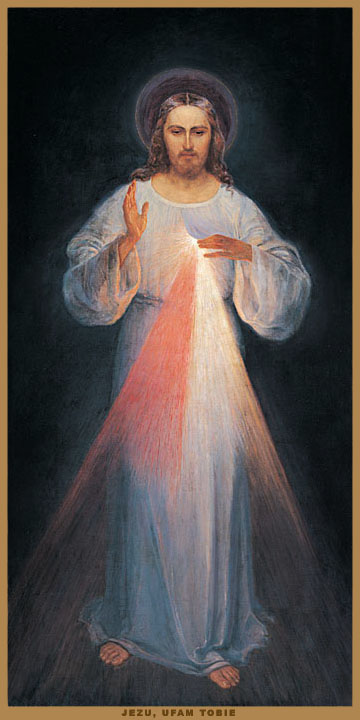
(artwork Christ's appearance to the Apostles, by Andrey Mironov CC BY-SA 3.0 via wikimedia commons;  Jesus, I Trust in You, by Eugeniusz Kazimirowski  public domain via wikimedia commons)

Tuesday, May 7, 2013

Wandering Desire


A reflection on John 14


Jesus said to his disciples:  “Whoever loves me will keep my word, and my Father will love him, and we will come to him and make our dwelling with him.  Whoever does not love me does not keep my words; yet the word you hear is not mine but that of the Father who sent me.  “I have told you this while I am with you.  The Advocate, the Holy Spirit, whom the Father will send in my name will teach you everything and remind you of all that I told you.  Peace I leave with you; my peace I give you.  Not as the world gives do I give it to you.  Do not let your hearts be troubles or afraid.  You heard me tell you, ‘I am going away, and I will come back to you.’  If you loved me, you would rejoice that I am going to the Father; for the Father is greater than I.  And now I have told you this before it happens, so that when it happens you may believe.  JN 14:23-29

Ascension of Jesus
When I was a little girl my family moved to Minnesota and we joined the local Presbyterian Church.  It was in this church that the love of Jesus was cultivated in my heart.  And though the church of my childhood lacked most of the sacraments, they did direct us toward a relationship with Christ. I especially remember Miss Peggy reading us stories about Jesus, helping us to memorize the books of the Bible and to understand the parables through delightful songs.   It was made clear to me that I could be bold like Zacchaeus or Bartimaeus and call out to Jesus.  I could expect Jesus to come to me in prayer, to heal me and to save me.  I prayed to Him frequently and I did hear His voice. 

 As I journeyed on in life, I wandered off the narrow path, I crowded out the voice of the Lord with what seemed like more fulfilling and realistic pursuits.  I remember a particular moment I had wandered so far away from Him that I stood on the brink of renouncing a belief in the historicity of the life, death and resurrection of Christ as I had learned from the Bible.  I was ready to dismiss it as all spiritual concepts and nothing more. In those moments I found I had only the strength to proclaim an abstract spirituality and vague ethical guidelines.  Yet that love that had once been nurtured but was now lying dormant in my soul stirred up painfully in the moment of my temptation.  It was a nostalgic-like yearning for something that I could not quite put my finger on, at the same time I felt contempt for this feeling, I tried to dismiss it as foolish and un-intellectual but the feeling was persistent.
    
C. S. Lewis in his essay The Weight of Glory talks of what he calls a wandering desire for the transtemporal.  This desire is present in each of us and there is no natural satisfaction for it in this world because we do not belong to this world – we are exiles!   Deep in our hearts God has placed a yearning to dwell with the Lord, where we truly belong, and where our identities are truly fulfilled.  And not just “spiritually”, but the whole of our being.  Our bodies as well as our souls.  We belong in the gleaming city on the mountain, we are destined to bathe in the waters of the Spirit that flow from the Temple, to eat from the Tree of Life and bask in the light of the Lord, to be known by Him, to have Him delight in us.   We catch glimpses of eternal joy in this world, but they are fleeting and utterly beyond our grasp, though we try in so many misdirected ways to capture them.  I felt these stirrings in my youthful prayers to Jesus, and occasionally as I pass through my life, I am visited by moments where peace and joy seemed to pour out upon me.  But these moments always slip quickly by, and even as I am enjoying them I am aware of a sorrow that always co-mingles with this joy.  Because it is lost almost as soon as it is received.  If we have lost our relationship with Christ, it is so easy to lose any sense of peace that we are being drawn on toward something greater, we feel only loss and have no real hope of renewal.  Because what we seek we cannot find here.  The world’s peace always comes at a terrible cost.

Unfortunately for us, we live in a time of diminished imagination and dreary earthbound dreams of distant Utopian hopes.  “Almost our whole education has been directed to silencing this shy, persistent, inner voice; almost all out modern philosophies have been devised to convince us that the good of man is to be found on this earth.” (Lewis; Weight of Glory)  And how close I was to accepting that as the truth.  But what happened to awaken my awareness of how I had misunderstood and suppressed this wandering desire in me?  Fundamentally it was the love of Christ that was nurtured in my soul as a child.  Because I had heard His voice, and I longed to hear it again.   In that moment that I stood on the brink of disbelief I heard His voice quietly echoing a line of Scripture that I was not very conscious of at the time “Will you also leave me?” (John 6:67)  I literally dropped to my knees, because as the words were being spoken, I recognized His voice, and the other philosophies that I was flirting with were revealed to be barren, ugly and powerless in comparison to the voice I heard, which was so much like the vision of John in Revelations, containing with it all beauty and all love. My response was very much like Peter’s response to Jesus in the next verse, “There is nowhere else to go!”  I was always being beheld by Him and being drawn up by the bands of love.

After all these years, I still am astounded and grateful for how the very simple but earnest instructions of my parents and Sunday school teachers paved the way for that deeper conversion.   Now after having been a Catholic for a few years (okay for over 20 years, but who's counting?) I know how richly and concretely present He is in His Church, and how blessed anyone is who is born into our faith.  My love for Him has only deepened, and with this my attention to His words and how I am following them has sharpened.  So that, hopefully, when I walk into the world, and encounter the barren philosophies, His peace stays with me - even when I am opposed and confronted.  Because I am not just bringing my ideas of who Jesus is with me, but I am bring Him with me, I am letting His Spirit flow through me.  So that that wandering desire can be stirred up a bit in those that I interact with.  But first, I must love Him, and in loving Him I can follow His words.  

Sunday, April 21, 2013

My Sheep Hear My Voice.


A reflection on the readings for the Fourth Sunday of Easter, 2013


Thereadings this Sunday call us to martyrdom; to witness in strength and love to the Lamb who shepherds us and fills us with His joy.  How do we gain the confidence of Paul and Barnabas to be a witness to the truth of the Gospel?
 
John: 10:27-30
Jesus said:  “My sheep hear my voice; I know them, and they follow me.  I give them eternal life, and they shall never perish.  No one can take them out of my hand.  My Father, who has given them to me, is greater than all, and no one can take them out of the Father’s hand.  The Father and I are one.”


By, Luke Knofczynski
 Luke's drawing of him listening to Jesus
Do you know His voice?  How do you learn to hear his voice?  These were questions that came up in our recent Kyrion meeting.  Kyrion is a prayer group for children that we have at our parish.   We are a small group under the umbrella of One Heart~One Fire.  The format for our small but faithful group starts with praise of God in song, an opening prayer, then we read, discuss, act out, meditate and journal on the Gospel for the upcoming Sunday.  We end with prayer.  We are trying to ignite a love for the Father in the hearts of the children, and to lead their hearts to know His voice.  And we are faithful and obedient to the teachings of our Church.  She is our guide into the heart of Christ.  Yet, it is a tall order.  There is an initial discomfort among all the children.  Jesus sometimes says strange things, challenging things.  It may be easier to keep a safe distance.   Even the children perceive this and our culture encourages it.

And this stirs up a bit of nervousness.  Truly, If you were to walk into our room in the middle of one of our meetings you would see what may look like chaos, in fact, it often feels like chaos to me (especially if I happened to have my toddler, Max, along).  To our eyes the rambunctious children do not seem to be ready or able listen and hear the Word of the Lord.  But our eyes miss a lot.   It is hard to perceive the very small movements of God in the ordinary messiness of our daily lives.

After my first few, very, very, VERY noisy and rowdy Kyrion meetings this year, I was tempted to give in to the feeling that it really was not worth the effort on a Friday afternoon, when I would much rather go home and relax with my family after a long week.  After all, we went to Mass that day, we will pray our nightly decade of the Rosary with the children before they go to bed…what more do we need to do?  Yes, Mass and devotion to our Blessed Mother are foundational to this ministry, but God has shown me, through many different means, how dangerous the attitude of "I have done enough" can be.  It can seduce you to compartmentalize faith.  It can induce a complacency in our soul and - I think we can see this in our culture - this complacency reduces our ability to love others with the passionate and fiery love of Christ; with a love that witnesses His love.  We will become lukewarm.  We will not be able to perceive evil, we will be easily deceived and truth will be inverted.  Thus I persevere with our other families. I have learned, over the course of the years how much He can do with a little perseverance on my part.  I am learning to notice the still,  small movements of His Spirit which reveal that the sheep are listening.

By: Sophia Knofczynski
Sophia's drawing of Jesus
In fact, on many Sundays, when the Gospel is read at Mass (or during the children’s liturgy he sometimes attends) my son Luke will comment on how we read that in Kyrion, or how he got to play the part of Jesus in that Gospel during Kyrion, or how he drew a picture of Jesus when we journaled on the Gospel.  He is engaged in the readings at Mass in a way that he would not otherwise be.  He is given permission to understand that the Word of God is written for him.  This is not selfish, it is learning to recognize the voice of the Lamb, the shepherd of His people.  In fact, it is giving him the courage to respond to His word in a way that will witness to others.   And he will need the courage; our children will need to know the voice of Jesus.  For some form of martyrdom awaits all of us who listen to and obey the shepherd’s voice, but we are assured that even if we suffer for His sake in this world the Father will not allow you to be lost.

I, John, had a vision of a great multitude, which no one could count, from every nation, race people, and tongue.  They stood before the throne and before the Lamb, wearing white robes and holding palm branches in their hands.  Then one of the elders said to me, “These are the ones who have survived the time of great distress; they have washed their robes in the blood of the Lamb.  “For this reason they stand before God’s temple.  The one who sits on the throne will shelter them.  They will not hunger or thirst anymore, nor will the sun or any heat strike them.  For the Lamb who is in the center of the throne will shepherd them and lead them to springs of life-giving water, and God will wipe away every tear from their eyes.”  Rev 7:9, 14 B-17

So it is imperative that we learn to hear His voice!  We need to teach our children that He is always speaking to us.  In our meeting, we ran a simple game with our children.  They were each blindfolded, and we (their mothers) scattered around the room and all called to them.  They had to listen and discern where their parent was.  They all succeeded.  Why?  Because they live with us, because they communicate with us.  They have learned to know our voices for their own safety, and for their individual needs for nurturing and love.  We learn to hear His voice by living with Him every day, in His Word, in prayer, by frequently coming to Him in adoration, in the Sacraments, in repentance.   Do you know His voice?  You must or you will be lead astray. You must know His voice and be prepared;  because sometimes He asks His followers to do hard things.  To love impossible people.  To forgive unspeakable crimes.  To proclaim Him in terrifying situations.  But in Him you can endure times of great distress, and confidently rejoice that your will be worthy of everlasting life where God Himself will wipe away every tear.

We are His people the sheep of His flock!  Amen!  Alleluia!

Heidi 

Sunday, April 14, 2013

Do You Love Me?


  A reflection on John 21:  15-19


Do you pray with the Scriptures?  When you read them, do you allow a word or a scene from the passage to speak to you in your heart and draw out from you a prayer?  It is essential for each of us enter into prayer in this way.  Yet, it is a direction that many "voices" - from the world, and from your own ego - will dissuade you from; because it will reveal your idols, your weaknesses.  The Lord seeks to lead us out of those "Egypts" in each one of our souls.  To do so demands much; it demands a love that endures all things, hopes all things and to be completely truthful, I do not have that love yet.  That is important for me to understand, not for me to despair but so that I can live in His truth, endure in His light and be drawn up into a more perfect love by following His voice.  


Picture by Heidi Knofczynski, taken during a lesson on John 21:1-19


When they had finished breakfast, Jesus said to Simon Peter, “Simon, son of John, do you love me more than these?”  Simon Peter answered him, “Yes, Lord, you know that I love you.”  Jesus said to him, “Feed my lambs.” He then said to Simon Peter a second time, “Simon, son of John, do you love me?”  Simon Peter answered him, “Yes, Lord, you know that I love you.”  Jesus said to him, “Tend my sheep.”  Jesus said to him the third time, “Simon, son of John, do you love me?”  Peter was distressed that Jesus had said to him a third time, ‘Do you love me?’ and he said to him, “Lord, you know everything; you know that I love you.”  Jesus said to him, “Feed my sheep.  Amen, amen, I say to you, when you were younger, you used to dress yourself and go where you wanted; but when you grow old, you will stretch out your hands, and someone else will dress you and lead you where you do not want to go.” He said this signifying by what kind of death he would glorify God.  And when he had said this, he said to him, “Follow me.”  John 21: 1-19


Simon, son of John, do you love me?

I need to live in His truth, I need to know who I am and  who I am called to be in His truth.  I need it desperately, and our whole culture is dying for lack of this truth.  In this Gospel, through the questions of Jesus, Peter is taken back into the bitter, memory of his betrayal of the Lord, in order to receive the profound, unfathomable mercy of Jesus so that he can be drawn up into His perfect love. What courage this takes!  We, who are so easily offended, we, who so often confess our failings in a self-justifying context, are also taken through the drama of the Lord's threefold questioning of Peter.  Three times he questions Peter’s love for Him, mirroring the three times that Peter denied Him. The anguish of Peter by the third round is palpable. I can understand this, it can be agonizing to allow Christ to plumb the depths of our individual depravity.  Especially in this hyper-sentimentalized culture, where there is no incentive to grow in a deeper more perfect love,  to have cowardice and unwillingness to suffer in order to grow in love revealed in the unflinching light of His gaze is terrifying.  Who really wants to face their own spiritual impotency?  Yet, to grow in His perfect love is to drive out fear (1 Jn, 4:18), because above all we are afraid of our own ultimate futility - our own spiritual impotency.  Christ is the only possible answer to that fear.  Moreover, when Peter submitted to Our Lord’s probing and tending to the wounds of his darkest failure, we are shown that his little love was enough for Jesus, who would transform that little love into perfect love.  And then we see how much potency in the Spirit is released!  

We must obey God rather than men!

Perfect love does drive out fear!  Look at how Peter and the apostles rejoice at the sufferings and worldly dishonor they receive on account of the Lord! (Acts 5:41) How can I be released from the bonds of my spiritual impotency?  How can I be freed the dark hidden wounds in my soul?  These wounds may not always be obvious, but they have a subtle control over my love. Again, I am not speaking of the sentimental love of our time, but the passionate, agape love of God.  The love that bears all things, believes all things, hopes all things, endures all things. (1 Cor 13:7)  This is the love that our fears would block us from entering into.  This is the love that Christ will so gently draw from you, if you, like Peter, allow His Spirit to enter into your darkest wounds and heal them.  And not just heal them, but as we see in Peter, transform them!  His cowardice, in the power of this love, is lifted up to courage.  The Fisherman from Galilee will endure humiliation and martyrdom for Christ and His Church.  “I will praise you Lord…You changed my mourning into dancing!” Psalm 30 2;12

Worthy is the Lamb!

It seems a little unbelievable.  In this age of stunted, materialistic love, we may be a bit jaded in our hope that we could encounter Christ as intimately as Peter did merely from reading the words of Scripture.  We may be afraid to enter into the contemplative prayer that will bring us to Christ in this profound and personal way.  Do it anyway.  Put aside your fears, suspend you disbelief.   When you read the Gospel, when you hear it proclaimed at Mass, place yourself in the readings in your imagination.  Yes, there may be detracting voices -inner voices, worldly voices- that will hurl all sorts of accusations and distractions at you.  Yes, it may take time to build up an ability to endure in this type of prayer.  Yes, you may have to let go of the insipid, sentimentalized one-dimensional Jesus that is too often presented to us;  this Jesus inoculates us against the One who is the worthy Lamb of God, in whose presence all creation trembles and cries out to in adoration. (Rev 5: 11-14)  Persist!  And be ready, because He will surprise you.  Like He did for Peter, Jesus will ever so gently direct you to true repentance and deep healing. He will take your breath away and you will begin to let the Spirit breath through you. 

You brought my soul up from Sheol

My own experience in this type of prayer is an example of how important it is to persist through those false voices.  For many years in prayer I have entered into the scene of the sinful woman we read of in Luke.  In this prayer I am the women attempting to approach the Lord, but the Pharisees are standing in my way.  They present every objection imaginable to discourage me from persisting to see the Lord.  They accuse me of my own unworthiness and some of their accusations are devastatingly accurate.  The worst one is:  “Just who do you think you are!”  They go on:  “You do not belong here, you never will!"  "You do not need Him as much as others, how presumptuous of you!"  You ought to be content to just look at Him from afar, He will just send you away!”   It has really taken me years to get through that gauntlet in any meaningful way.  Even when I did persist and I fell at His feet, I could not look at Him - I was too afraid.  And in my day to day life as well, I can tell you that this fear, fundamentally a fear of rejection, has stopped me from doing many, many things that I ought to have done.   But, one day I did look up at Him.  And He looked at me with eyes that were strong and serious, and unfathomably loving and said:  “ Well, who do you think you are?”  Wow!  Those words from Him seemed to be my worst fear coming true, but the Lord’s eyes never wavered, and drew from me the answer “I am yours.”   And He responds, “ You did not choose Me, I choose you:   Follow me.”

Alleluia!

 Take a moment to enter into this Gospel in prayer (or whatever Biblical scene you are drawn to). What would He ask you?  In those moments of prayer, much like Saint Peter encounter with the Lord, Jesus will draw you to look at yourself with unflinching honesty, but bathed in His light you begin to receive the courage, the power to be so much more than forgiven:  to be transformed, to be potent and fruitful in His Spirit.  Follow Him!

Christ is Risen!  Alleluia!
Heidi 

This post is featured on Catholic Spirituality Blogs Network, a great site to find Catholic blogs!

Saturday, January 5, 2013

An Epiphany


A reflection on the Solemnity of the Epiphany of the Lord


Opening prayer for the Solemnity of the Epiphany of the Lord:
May the splendor of your majesty, oh lord we pray, shed its light upon our hearts that we may pass through the shadows of this world and reach the brightness of our eternal home.

Having just returned from visiting my family in Minnesota I must say that as I pass through the shadows of this world I stumble quite a bit!  Especially around my extended family!  How is one to be a light to others when one spends so much time stumbling over personal ineptitude and in-eloquence.  I do not know how to  respond to hot button moral issues, like "same-sex" marriage or cohabitation - issues that hit very close to home for several of my family members-  without stumbling into to cold superiority, or succumbing to moral relativity!!!  If  I finally muster the courage to say anything, in my effort to navigate somewhere between both extremes, my words come across as weak and confused, too spiritual to be practical, too vague to be understood!  So mostly I shut up, and pray silently for light.  But I always feel that I ought to have done more.
 
Even as I despair of ever serving my Lord in courage and in truth,  as well as in compassion, the light of the star that guided the wise men to Truth Himself is once again brought forth in the liturgy of our Church.  And the message is to keep following, keep praying, to keep adoring, to nurture an interior awareness that all creation is in some way revealing the Mother and her Son, and to allow the majestic beauty of the Nativity of our Lord to draw me out of myself, deep into His Spirit. Just in pondering the Nativity, particularly as I listen to some of the beautiful and sacred hymns of Christmas, all my frustrations and anxieties over my family disagreements, wash away, all of my personal struggles and failures with disordered desires become a bit more ordered.  

In fact, what is illuminated is that my anxiety is caused by my pride.  A pride that will not bear the misguided accusations of being uncaring or unkind or hateful.  My pride that bristles at the attempts by a few family members to bait me and others into a discussion that will only cause discomfort and embarrassment to other members of our family. My pride that would love to find the right words to put them in their place, or to lead them to the light...except it would be my light and not the splendor of His majestic light.

And once I step out of the shadow of my pride I can now perceive an interior light:

  "Whatever is true, whatever is honorable, whatever is just, whatever is pure, whatever is lovely, whatever is gracious, if there be any excellence and if there is anything worthy of praise, think of these things.  Keep on doing what you have learned and received and heard and seen in me.  Then the God of peace will be with you." Philippians 4: 8-9 

I know that is not one of the readings for this Sunday, but, for me, it was like the star of Bethlehem, directing me to let His light shine through me, through focusing on the goodness in even those who oppose me.  Doing this protects me against trying to illuminate truth (or rather, cut down my enemies) through my fancy words or my forceful arguments.  It does not mean that I do not defend truth, or hide my faith away. If I must defend truth with arguments and debates, I will be guided by the light those inspired words of Saint Paul.

  And somehow I am strengthened with these thoughts and now I can simply serve Him in love and endure with Him in the shadows of the world.  I can bask in adoration of the little child who has come for me.  I can be drawn into His heart by the beauty of His Mother. If others have not yet perceived the light, if they have not yet perceived a desire for God in all of their deepest desires, than as the Magi left Herod in his darkness to  rejoice in and follow the light, I must continue on to follow God, and trust that God does not intend to leave anyone in darkness who is truly searching for the light.  Maybe they will follow.  Maybe their hearts desires will be revealed as they step into the splendor of His majesty.

Come and adore Him.  Be drawn unto Him by His light!.  

Rise up in splendor, Jerusalem!  You light has come, the glory of the Lord shines upon you.  See, darkness covers the earth, and thick clouds cover the peoples; but upon you the LORD shines, and over you appears his glory.  Nations shall walk by your light, and kings by your shining radiance.  Raise your eyes and look about you; they all gather and come to you:  your sons come from afar, and your daughters in the arms of their nurses.  Then you shall be radiant at what you see, your heart shall throb and overflow, for the riches of the sea shall be brought to you.  Caravans of camels shall fill you, dromedaries from Midian and Ephah; all from Sheba shall come bearing gold and frankincense, and proclaiming the praises of the Lord!  Isaiah 60:1-6 
Merry Christmas!
Heidi 


Oh!  And just for fun, because this made me laugh:


Saturday, November 17, 2012

Let Your Joy Shine!


 The readings for this Sunday, the Thirty-third Sunday in Ordinary time, are pretty dramatic.  They are leading us to the end of the liturgical year, and so we look the the end of time, and to the return of Christ the King, which is next Sunday's celebration.
In those days, I Daniel, heard this work of the Lord: "At that time there shall arise Michael, the great prince, guardian of your people;  it shall be a time unsurpassed in distress since nations began until that time.  At that time your people shall escape, everyone who is found written in the book .
"Many of those who sleep in the dust of the earth shall awake; some shall live forever, others shall be an everlasting horror and disgrace.
"But the wise shall shine brightly like the splendor of the firmament and those who lead the many to justice shall be like the stars forever."  Daniel 12;1-3
Are you prepared for times of great distress and upheaval?  No..... in spite of a my disappointment in the election and the Mayan 2012 prediction of the end of the time, I am not prophesying the end of the world.  I keep in mind always the final words of today's Gospel:  "But of that day or hour, no one knows."  However,  since we do not know the day and hour, or even our individual day and hour, we must always have our faith and hope fixed on Jesus, who shows up the path of life through the dark valleys we will encounter.  Because He has forged the way through death.  In fact, though these readings bring to mind the ultimate futility of this world, reminding us of our present darkness and our looming doom, the Church is calling us to rejoice!  When that time does come our King is coming to gather us to Himself!
Therefore my heart is glad, my soul rejoices; my body also dwell secure, for you will not abandon my soul to Sheol, nor let your devout one see the pit.  You will show me the path to life, abounding joy in your presence.  Psalm 16: 9-11
As I read, prayed and re-read these readings a person kept emerging in my mind.  The saint Maximilian Kolbe.  I think of him because he died in Auschwitz with a group of others chosen to be starved to death in a horrible underground bunker.  It was a punishment inflicted on prisoners of Auschwitz whenever one of them escaped.  Designed to be produce a distress unsurpassed so that prisoners would be very motivated to prevent any other escape attempts.  But with Maximilian Kolbe in that  bunker, instead of the usual loud and horrifying suffering and pleas for help, they were led in singing hymns and prayers.  Maximilian encouraged them by giving them hope in the eternal inheritance of Christ our Lord, and in the everlasting beauty of their heavenly mother Mary.  He brought the joy of heaven into that awful place, and like a star shining brightly he lead those poor souls to justice.  That is what the Lord will do for each of us if we pray for the faith to hold fast to Him. 

It takes a profound joy, rooted in faith to be a light in the dark.  We need to be realistic about our passing  world, and we need to transmit the joy of our confidence in our Savior, who through His sacrifice leads the way through desolation and despair.  In His presence there is abounding joy, contagious and overflowing to those who wish to receive it. This joy does not mean you will be immune to suffering; I am not suggesting for one minute that the pain and suffering of Maximilian and the others was any less horrible than it had been for others, but faith in the eternal joy of heaven allowed them to endure in their suffering with a abiding hope and an inspiring courage.  This faith means that in suffering, and times of distress you can be a light to others.  Pray always for an increase of faith in Him, and love for all you meet, so that your joy can shine like the stars.

Oh, and here is another person that radiated the joy of the Lord, this is an admittedly light-hearted video that I found while reading Simcha Fisher's blog over at National Catholic Register. All of my friends have agreed, that like Simcha, first they hated it, thinking it a flippant video of our beloved Pope, then they loved it, because it overflows with the love of Christ and the joy of Blessed John Paul II!  


Peace and grace to all of you!  
Heidi

Saturday, September 22, 2012

What Were You Arguing About?


What is the antidote to the blinding whirlwinds of selfish ambition and jealous envy? It is not simply to  reject our ambitions, passions or desires, we must daily submit these desires to the reality that the earthly fulfillment of them is not necessarily the goal.  As C.S.Lewis says in his essay The Weight of Glory  "We are far too easily pleased",  however, we are never deeply satisfied. This Sunday's readings are filled with the consequences of selfish ambition, which may temporarily please us, but in reality will blind us to our real needs.  Which explains Saint James in the second reading where he explains why we do not receive from the Lord what we ask for.  We do not know what we really need.  As I read over the Gospel for this Sunday I was thinking of another C.S. Lewis quote from the same essay. "It would seem that Our Lord finds our desires not too strong, but too weak. We are half-hearted creatures, fooling about with drink and sex and ambition when infinite joy is offered us..."   But how do we strengthen and hone our ambition for this eternal joy, how do we catch sight of our hearts desire?

Mk 9:30-37

"Jesus and his disciples left from there and began a journey through Galilee, but he did not wish anyone to know about it.  He was teaching his disciples and telling them, 'The Son of Man is to be handed over to men and they will kill him, and three days after his death the Son of Man will rise.'  But they did not understand the saying and they were afraid to question him.

They came to Capernaum and, once inside the house, he began to ask them, 'What were you arguing about on the way?'  But they remained silent.  They had been discussing among themselves on the way who was the greatest.  Then he sat down, called the Twelve, and said to them, 'If anyone wishes to be first, he shall be the last of all and the servant of all.'  Taking a child, he placed it in their midst, and putting his arms around it, he said to them 'whoever receives on child such as this in my name receives me;  and whoever receives me, receives not me but the one who sent me."

Jesus instructs his disciples, they perceive in His words deep mysteries, and profound destinies, but they are afraid to go deeper with Him.  Maybe they are afraid of what Jesus is predicting:  Suffering?  Death?  They do not seem to quite understand what He means by resurrection.  Even so, great ambitions and passions are stirred up.  And, as often happens in our human weakness, these passions are misunderstood, and  misdirected.  Their half-hearted understanding of the unlimited love of God leads them to apply the energy of these great stirrings in their soul to arguing about gaining earthly glory for themselves.  They have missed the higher calling of their Lord. They are following the ambitions in their hearts along a very horizontal trajectory, but Jesus is leading them to the heights of glory, and you cannot get attain that through egotism.  Then, later on in the day when they had come to a place of rest, Jesus asks them "What were you arguing about on the way?"

Right here is the opportunity to depart from the earthbound path.  Do you take a moment each day to allow the Lord to speak to you, convict you and redirect you?   Do you take at least a quiet minute or two for a daily Examen? In the Gospel there is a silence that follows the Lord's question.  This feels to me like an Examen prayer;  the twelve disciples, are not perfect, not always doing things with a deep understanding of themselves or of Christ (they sound a bit like me actually)...but, unlike the wicked men in the first reading, they have the humility stop and listen to Jesus, they have opened their hearts to Him enough to allow the Lord to show them where they are transgressing and where they are violating their training.  

And there is no need to be afraid to deeply examine your motives and your desires with His help, as the disciples originally were.  The Lord will not harshly condemn all of your misdirected passions and desires; He will show you what they are for.  He will purify your vision for things that are eternal, and this will reorder your desires.  He will help you to take your focus off of yourself so you can see the least and the weakest around you and you will bear upon yourself a bit of the weight of their salvation, to weaken your selfish motives - for you can never expect any earthly compensation for this service. And with a purer vision you will see that the initial desire for greatness and glory is an inborn desire to catch the eye of the Beloved and have him smile upon you.  It sounds like such a little thing, so easily overlooked for what appears to be  glitzier and grander achievements in the here and now, and yet it is everything.  But it takes time and a willingness to listen in prayer and attune yourself to the deep stirrings of His Spirit in your soul.

In the end the ambition and desire to be the greatest is not necessarily an evil if you submit your motives to Christ's direction. It is our fallen response to the longing to be approved of and enfolded into the arms of the Father.  The fulfillment of our deepest desire is to be that child wrapped in the arms of Jesus. 

Update

I don't know why, but I really think that this song is a great preparation for anyone who might feel just a little intimidated by allowing Jesus in to direct all the strength and potency of our passions to the fulfillment in the love that awaits you in the arms of Jesus.  Do not be afraid to allow Him to show you where your passions are directing you!  

Peace and Grace!  Heidi


Saturday, April 14, 2012

Platitudes or Water, Blood and The Spirit

Beloved:  Everyone who believes that Jesus is the Christ is begotten by God, and everyone who loves the Father loves also the one begotten by him.  In this way we know that we love the children of God when we love God and obey his commandments.  For the love of God is this, that we keep his commandments and his commandments are not burdensome, for whoever is begotten by God conquers the world.  And the victory that conquers the world is our faith.  Who indeed is the victor over the world but the one who believes that Jesus is the Son of God? 
This is the one who came through water and blood, Jesus Christ, not by water alone, but by water and blood.  The Spirit is the one that testifies, and the Spirit is truth. 1 John 5:1-6

I have recently participated in a Facebook debate, and this one was particularly unpleasant, one side claiming to be on the side of love and tolerance, the other (the side I was "liking") was asking for justification for abusive and slanderous posts that included an inflammatory picture of the a bishop with the word bigot scrawled across it.  We received no justification, only over-generalized reasons for disdain of the Catholic hierarchy and Catholic moral teachings and, of course, the standard Jesus platitudes were stated and restated. Calling a bishop a bigot was rationalized and defending him called sown an angry tirade of how we were: "casting stones"and how we should "remove the beam from our own eyes!"   It was ugly and it was sad.  Love was diminished to complacent acceptance, if you did not accept what they accepted you were of course, rejected.

What do I mean by a Jesus platitude?  A platitude is a statement , supposedly profound, but in reality it is flat, dull and banal.  How can anything that the Alpha-Omega, Eternal son of the Living God, victor over the universe and all powers of darkness be banal and trite?  The answer:  When you remove it from the deep and profound Truths that the Lord God revealed to the Children of Israel and her prophets.  Then, the summation of the law:  Love God above all and love your neighbor as yourself, becomes so malleable that it essentially means whatever the follower wants it to mean.  So, the biggest problem with Jesus platitudes is they stifle the power of Jesus' love by reducing His power to mere words; then they trivialize and relativize it.  In a way, they inoculate you against the transformitive love of Christ.   Now, His love merely accepts you, it does not transform or reform you.   Since we are truly made for higher pleasures - we have much more heroic ambitions and deeper desires of which platitudes only superficially address - and are often used to excuse the misdirection of these ambitions and desires -  this can only lead to shallow love and ultimately to angry despair. Because despite all of your efforts to live a life that is worth living, without being begotten by God you will not even be able to live up to the platitudes.  There is no way to live an integral moral life with such great desires, so many earthly pleasures and this banal version of the Lord.

So when I read the second reading, especially grounded in the rest of this Sunday's readings, I see a much fuller picture of how the love of Jesus transforms, and of how it is nourished and inflamed and regenerated in the sacraments of the Church.  He first speaks of belief in Jesus, and then of obedience to the commandments, obedience that is empowered by His love in us.  The last passage grounds our relationship with Jesus in his flesh and blood, not merely words and platitudes, but as a man who loved us so passionately that He poured out his blood from his pierced heart for each one of us.

Pope Benedict XVI in his book Jesus of Nazareth explains verses 6-8, the verses about water and blood and Spirit this way:

  "Here John very obviously gives the motif (of blood and water) a polemical turn against a form of Christianity that acknowledges Jesus' Baptism as a saving event but does not acknowledge his death on the Cross in the same way.  He is responding to a form of Christianity that, so to speak wants only the word, but not the flesh and blood.  Jesus' body and his death ultimately play no role.  So all that is left of Christianity is mere "water"-without Jesus' bodiliness the word loses its power.  Christianity becomes mere doctrine, mere moralism, and intellectual affair, but lacks any flesh and blood."
My Facebook encounter left me sad because I saw an intellectualized faith, that was really highly moralistic but not at all grounded in authentic love or objective morality, thus all the moralizing was to affirm others in being possessed by their passions instead of seeking the One to whom those passions point to.  Anyone who rejected this was treated to a barrage of words; quotes from Jesus thrown at them like the stones.   Yet, in a true encounter with  Christ your passions, your love and your desires will begin to be reordered to their true purpose.  It is impossible without Christ, but as you fall deeper in love with the Jesus -  the authentic Jesus who is flesh and blood, strength and power - you will find that His Passion is reforming yours.

If that sounds too ethereal, I can assure you that it is not.  But it takes daily prayer, and Scripture.  It takes sacrifice and sacraments.  It takes a willingness to look to Christ not as a one dimensional moral and spiritual teacher, but as the Beloved, the Eternal Flame which burns but never consumes, the pillar of fire, the still small voice, the thunderous theophany carving His law into stone and then on Calvary pouring out his Spirit into out hearts. He is the Divine lover, and in Him all things are fulfilled.  The depth of love that you are willing to enter into with Him will not be burdensome, when you love some one deeply wellsprings of strength and courage build up and you will live a life that has much more to offer than mere platitudes.

Peace and Grace
Heidi

BTW, if you have time Monsignor Pope's latest article is not to be missed!

Thursday, January 12, 2012

"Speak Lord...

Sunday's reading from 1Samuel is the beautiful story of the prophet being called out of sleep, into service for the Lord. Having been dedicatd to God by his mother, Hannah, before his birth, this account relates the dramatic recognition of Samuel, with the help of the priest, Eli, that his time has arrived. In the Hebrew Scripture, I have found three powerful "epiphanies", if you will, that illuminate God's revelation to individual's that can help us discern our own unique calling.


The first is the story of Jacob's dream on his journey to Haran in Genesis 28. After he awoke from his sleep, Jacob exclaimed, "Truly,...the Lord is in this place and I knew it not!"(v.16) Jacob vowed that if God remained, protected and sustained him, then the Lord would be his God. His realization that that the Lord was with him, "in this place", must be ours, too. God is not only found in the church, the temple, mosque or synagogue. God is in all places, at all times. It is impossible for us to be without Him. He envelops and embraces all things, and all creation is a manifestation of His love for us. And because He is everywhere, it is possible for us to be in a constant relationship with Him. And we should be open to a communion of the heart with the One who loves us, and is always with us.

St. Alphonsus Liguori, writing about the importance of silence, said that Our Lord had spoken to St. Theresa of Avila, saying, "I would willingly speak to many souls, but the world makes so much noise in their hearts that My voice cannot be heard." The prophet Samuel was asleep when God spoke to him.(1Samuel 3) But Samuel was unfamiliar with the Lord's voice, so he needed Eli to help him discern.

Since the Lord found St. Theresa's 16th century world noisy, imagine what He thinks of the clamorous, constant self-inflicted "jibber-jabber" of 21st century America? How is He heard amidst the clatter? God speaks to us through our friends, our family and even those who hate us. He speaks to us in events, through our joys as well as our personal tragedies. In all our relationships, and in the people who drift into and out of our lives, God's voice may be heard. Eli was present for Samuel. We may also need an "Eli" to help us decide among the din, whose voice is the Lord's. Or, we may be an "Eli" for others, through listening, talking, praying or simply being present. But we must realize that God is calling, and like Samuel, we need to listen.

In Isaiah 6:8, he says,"Then I heard the Lord saying, "Whom shall I send? Who will go for us?" "Here I am," I said, "send me!" Once we acknowledge God's Presence, and that He speaks to us, we have a choice to make: Do we give ourselves to Him, or, do we "harden our hearts" and reject His call?

Concerning our response, Trappist monk Thomas Merton wrote, "All our good acts are acts of consent to the indications of His mercy and the movements of His grace...which seeks nothing to respond, by goodness, to Goodness, and by love, to Love. Let us not only exist, but obey in our existence. For the full fruitfulness of spiritual life begins in gratitude for life, in the consent to live, and the greater gratitude that seeks to be dissolved and to be with Christ."

So, we begin with gratitude, with giving thanks in all things. Isaiah knew that he was not his own, he was the Lord's. And in thanksgiving, gave himself back to his Creator. Every moment of our life is grace. And when we recognize, not by hearsay but by experience, that in His love, God has given us everything, including His Son, then there can only be one response to God's summons: "Here I am, Lord! Send me!"

Sunday, November 13, 2011

Fear of the Lord

November 13, 2011 33rd Sunday in Ordinary Time

The readings for this Sunday make me think of the term “Fear the Lord” or “Fear of the Lord.”

Our first reading is from the Book of Proverbs 31: 10-13, 19-20, 30-31.
When one finds a worthy wife, her value is far beyond pearls.Her husband, entrusting his heart to her, has an unfailing prize.She brings him good, and not evil, all the days of her life.She obtains wool and flax and works with loving hands.She puts her hands to the distaff, and her fingers ply the spindle.She reaches out her hands to the poor, and extends her arms to the needy.Charm is deceptive and beauty fleeting; the woman who fears the LORD is to be praised.Give her a reward for her labors, and let her works praise her at the city gates.

In this reading from Proverbs, the characteristics of a worthy wife are described. This woman brings goodness and love to her husband and to those around her. She cares for all those who need her and can be praised for her work. But her fear of the Lord is the most important reason for praising her. The capstone of her life’s work is found in that fear of the Lord.

Psalm 123 expands upon the concept of fear of the Lord and describes some of the blessings given by the Lord to those who fear Him. If we fear the Lord, we will do our best to walk in His ways. Just as the woman described in Proverbs is blessed because of her fear of the Lord, so the man described in this psalm is also blessed.

R. Blessed are those who fear the Lord.
Blessed are you who fear the LORD,who walk in his ways!
For you shall eat the fruit of your handiwork;blessed shall you be, and favored.
R. Blessed are those who fear the Lord.
Your wife shall be like a fruitful vine in the recesses of your home;
Your children like olive plants around your table.
R. Blessed are those who fear the Lord.
Behold, thus is the man blessedwho fears the LORD.
The LORD bless you from Zion:may you see the prosperity of Jerusalemall the days of your life.
R. Blessed are those who fear the Lord.

Finally, in our Gospel for today (Matthew 25:14-30), Jesus tells His disciples a parable about a man who entrusts his servant with talents, each according to his abilities. Upon the man’s return, he rewards or punishes these servants based upon their actions with regard to the talents which they were given. The master rewarded those servants who added to the number of talents they were given and punished the ‘useless servant’ who did not add to the talent he was given.

Jesus told his disciples this parable:"A man going on a journey called in his servants and entrusted his possessions to them.To one he gave five talents; to another, two; to a third, one -- to each according to his ability. Then he went away. Immediately the one who received five talents went and traded with them,and made another five. Likewise, the one who received two made another two. But the man who received one went off and dug a hole in the ground and buried his master's money.After a long time the master of those servants came back and settled accounts with them.The one who had received five talents came forward bringing the additional five. He said, 'Master, you gave me five talents. See, I have made five more.'His master said to him, 'Well done, my good and faithful servant. Since you were faithful in small matters,I will give you great responsibilities. Come, share your master's joy.'Then the one who had received two talents also came forward and said, 'Master, you gave me two talents. See, I have made two more.' His master said to him, 'Well done, my good and faithful servant. Since you were faithful in small matters, I will give you great responsibilities.Come, share your master's joy.' Then the one who had received the one talent came forward and said, 'Master, I knew you were a demanding person, harvesting where you did not plantand gathering where you did not scatter; so out of fear I went off and buried your talent in the ground. Here it is back.' His master said to him in reply, 'You wicked, lazy servant! So you knew that I harvest where I did not plant and gather where I did not scatter? Should you not then have put my money in the bank so that I could have got it back with interest on my return? Now then! Take the talent from him and give it to the one with ten. For to everyone who has, more will be given and he will grow rich; but from the one who has not, even what he has will be taken away. And throw this useless servant into the darkness outside, where there will be wailing and grinding of teeth.

In all three of these readings, ‘fear of the Lord’ leads to an increase in grace and blessings from God. The worthy wife continues to be blessed as she lives her life in accordance with the Lord’s will. The blessed man described in the Psalm also receives an increase in grace and blessing as he lives his life following in the ways of the Lord. Finally, the two servants who work to live up to the responsibilities given them also receive an increase in grace and blessings (talents).

Thinking about these readings led me to wonder about the third servant, the man who buried the talent given him. When the master returned, servant could only give back the single talent he had received. This “wicked, lazy servant” had made no effort to improve and grow. As Dom Vonier wrote, “The more a man has, the more God will give him, because there is nothing that pleases God more than to enrich his creatures, and whenever he sees a man making good use of his gifts, He pours more and more upon him with lavishness which is astonishing (Magnificat, Nov 2011).

As I look at how I live my own life, I begin to question myself. Do I truly fear the Lord? Do my daily actions reflect that fear? Or do I just float along, day after day, being content with where I am? Where is my desire to improve and grow? Do I consistently conduct my life in a way that reflects my fear of the Lord? Does the Lord say to me “Come share my joy?” Or am I often a “wicked, lazy servant?” This week’s readings have forced me to re-evaluate how I am living my life, and that kind of reflect is always a good thing. Spiritual growth never occurs in a vacuum.

Peace and blessings, Judy

Saturday, November 5, 2011

Readings for the Thirty Second Sunday in Ordinary Time (Sunday, November 6, 2011)

The readings for today make me think of the times we are asked to watch and wait for something to happen, someone to call, someone to come to us. It is so hard to just sit still and wait. Most people that I know are people of action; happy when they are doing something, not just sitting.


Our first reading is from the Book of Wisdom 6:12-16.
"Resplendent and unfading is wisdom,and she is readily perceived by those who love her,and found by those who seek her.She hastens to make herself known in anticipation of their desire;Whoever watches for her at dawn shall not be disappointed,for he shall find her sitting by his gate.For taking thought of wisdom is the perfection of prudence,and whoever for her sake keeps vigilshall quickly be free from care;because she makes her own rounds, seeking those worthy of her,and graciously appears to them in the ways,and meets them with all solicitude.
As Wisdom speaks to us, she is telling us of the wonderful gifts she has for us. If we seek her, we will find her. If we keep vigil for her, she will come to us. She seeks those who are worthy of her and her gifts. What could possibly make us worthy of the gifts of Wisdom? As we continue to ponder the reading for today, that answer may become clearer. "


Psalm 63 reminds us that we do indeed seek God and in seeking Him, we will find Him. Our souls thirst for Him. God is with us; we see His power and His glory and feel His kindness. Our response must be to bless Him, praise Him and ponder on Him.


"My soul is thirsting for you, O Lord my God.O God, you are my God whom I seek;for you my flesh pines and my soul thirstslike the earth, parched, lifeless and without water.R. My soul is thirsting for you, O Lord my God.Thus have I gazed toward you in the sanctuaryto see your power and your glory,For your kindness is a greater good than life;my lips shall glorify you.R. My soul is thirsting for you, O Lord my God.Thus will I bless you while I live;lifting up my hands, I will call upon your name.As with the riches of a banquet shall my soul be satisfied,and with exultant lips my mouth shall praise you.R. My soul is thirsting for you, O Lord my God.I will remember you upon my couch,and through the night-watches I will meditate on you:You are my help,and in the shadow of your wings I shout for joy.R. My soul is thirsting for you, O Lord my God."

Finally, in our Gospel for today (Matthew 25:1-13), Jesus tells His disciples a beautiful parable about watching, waiting and being prepared.


Jesus told his disciples this parable:"The kingdom of heaven will be like ten virgins who took their lamps and went out to meet the bridegroom. Five of them were foolish and five were wise. The foolish ones, when taking their lamps, brought no oil with them, but the wise brought flasks of oil with their lamps. Since the bridegroom was long delayed, they all became drowsy and fell asleep. At midnight, there was a cry, 'Behold, the bridegroom! Come out to meet him!'Then all those virgins got up and trimmed their lamps. The foolish ones said to the wise, 'Give us some of your oil, for our lamps are going out.' But the wise ones replied, 'No, for there may not be enough for us and you. Go instead to the merchants and buy some for yourselves.'While they went off to buy it, the bridegroom came and those who were ready went into the wedding feast with him. Then the door was locked.Afterwards the other virgins came and said, 'Lord, Lord, open the door for us!' But he said in reply,'Amen, I say to you, I do not know you.' Therefore, stay awake, for you know neither the day nor the hour."


Many commentaries tell us that “the wise maidens represent all those who possess the ensemble of virtues which characterize a complete Christian life. The burning oil lamps which they carry…symbolically portray Christian wisdom.” The oil that the five wise maidens have brought with them represents their personal virtue. Jesus is the bride groom for whom the maidens wait. W hen He arrives, he ushers them into the feast, those who waited for Him, sought Him, and sought His wisdom.


When I ponder all of these readings, I am reminded how important it is to “stay awake and be ready.” We need to focus on being Saints in the Making; always waiting for God in our lives. It is easy to look for God in our lives when things are not going well for us. We can recognize that “I need God; I cannot do this alone. I cannot discern what I should do; what is of God and what is not.” It may be more difficult to see God in our lives when things are going smoothly. We enjoy that feeling of contentment and happiness and it is easy to simply accept it rather than look for the source of these feelings.


God is always with us; sometimes we just don’t see Him in our lives because we are not wise enough to always watch and wait for Him. This week, I pray that we all receive the gift of watching and waiting for God and His Wisdom. He is near; we just need to seek Him.


Peace and blessings, Judy

Saturday, October 29, 2011

Psalm 131


This Sunday's readings contain one of my favorite Psalms:   Psalm 131,  it is short and it is humble.

Psalm 131: 1,2, 3:
Lord my heart is not proud, nor are my eyes haughty.  I do not busy myself with great matters, with things too sublime for me.  Rather I have stilled my soul, like a weaned child to it's mother, weaned is my soul.  Israel hope in the Lord, now and forever.


The response that we are to say is:  In you Lord, we have found peace.  Is that where you find your peace?  Why is peace so elusive?  Do you go to the Lord daily in prayer and give to Him all the things you busy yourself with through the day?  Do you fill your mind with the word of God, which is living and active? Could it be that we think that exterior peace leads to interior peace?

I know that there are times that my heart and soul get so wound up with activities great or small, debates about issues, great or small, that I am far from peaceful.  And when I am agitated and restless, I want to change everything around me, to do something that I hope will transform my turmoil into tranquility (or at least distract me from it). If I get everything in place around me, or if I can control my surroundings, I think that I should be able to attain peace in my soul.  I attempt to quiet my restless heart with what I do, what I have or who I love and am loved by in this world, so that I will be satisfied.

 But it is not so.  And it takes humility to realize it.  To humbly be weaned of the temptation to create false peace and to try so hard to control how others see you, treat you or honor you. We need to be content and humble in the presence of the Lord, or else we can fall into the trap of the Pharisees, who "preach but do not practice",  or the priests of Malichi 2, who" do not listen" and "do not lay it to heart".  They have achieved the places of honor, but have not submitted their hearts and minds to the Lord with humility and love.

 Thus, the Psalm is about prayer, and even great kings, who do have to busy themselves in the world with great and sublime things, must humble themselves and sit at the feet of the Lord where we all should submit our worries and joys, our successes and our failures to our true King.    And, if I do not understand that all true peace and lasting joy come from the Lord, and are gifts that are nurtured in prayer and quiet listening, even if I say I believe and trust in the Lord, I will fall prey so easily to false notions of peace, and false notions of faith. This Psalm calls us to a deep reliance and a stronger trust in the Lord, who at times seems to let the world spin out of control.

 The mother of a child who is being weaned knows that there are greater things for her child, and her child is ready to move on.  The child only knows that mother is withdrawing a comforting form of her nurturing love from him or her, and a very anxious child may be desperate to maintain this comfort with their mother. Here is where this child can grow in trust; the weaning process is not just the removal of a consolation and leaving the little one to comfort himself; what mother does not console her anxious child as they grow and mature leaving behind childish comforts?  But upon weaning they are beginning to understand that mother is still near, and still delighting in her child, and they can quietly rest in her lap without being upset at having moved on from earlier stages of nurturing.  She has not weaned them to burden them, but to free them.  Peace and humility are found in the trust and firm hope that even in middle of chaos and anxiety, when the Lord feels far away, He is still there, and nothing will separate you from His care.

Grace and Peace,
Heidi

Here is some wisdom from Deacon Paul Rooney about the readings for the Thirty-First Sunday in Ordinary Time.


Sunday, October 23, 2011

Sunday Reading October 22nd & 23rd

Sunday Reading October 22nd & 23rd
The Greatest Commandments

The readings for this Sunday remind us of the love God has for us and the love we are to have for Him and for our “neighbors.” God loved us first and that enables us to love Him.

The gospel for today is taken from Matthew 22:34-40.
“When the Pharisees heard that Jesus had silenced the Sadducees, they gathered together, and one of them, a scholar of the law tested him by asking, ‘Teacher, which commandment in the law is the greatest?’ He said to him, ‘You shall love the Lord, your God with all your heart, with all your soul, and with all your mind. This is the greatest and the first commandment. The second is like it: You shall love your neighbor as yourself. The whole law and the prophets depend on these two commandments.’"

The Jews of Jesus’ time had over 600 laws they were to obey. Jesus often commented about obeying the letter of the law versus the meaning behind the law. When I think about all these laws, I marvel at the complexity that must have existed. No wonder the Jews needed their elders to constantly interpret and monitor these laws.

Then Jesus spoke. He was God’s son, but was known as a simple man. A man of few words, carefully chosen and spoken often in parables. This time, Jesus spoke very clearly and distinctly. No hidden meanings, no metaphors. He condensed those 600+ laws into two basic commandments.

· We must love God with all of our being.
· We must love our neighbors as if they were us.

We move from complexity to simplicity. In all that we do and say we must consider the depth of our love for our God and the depth of our love for our neighbors. Everything else must be a subset of these two commandments.

We live in a complex world; often surrounded by sophisticated rules and challenges. And yet, if we look closely at our own lives and our world, it all boils down to our love of God and our love of humanity. Everything else becomes smoke and mirrors.

We hear in our first reading of today the words from Exodus 22:20-26 which remind us of our obligation to love humanity.

Thus says the LORD:"You shall not molest or oppress an alien,for you were once aliens yourselves in the land of Egypt. You shall not wrong any widow or orphan. If ever you wrong them and they cry out to me,I will surely hear their cry. My wrath will flare up, and I will kill you with the sword;then your own wives will be widows, and your children orphans.”

"If you lend money to one of your poor neighbors among my people,you shall not act like an extortioner toward himby demanding interest from him. If you take your neighbor's cloak as a pledge,you shall return it to him before sunset;for this cloak of his is the only covering he has for his body. What else has he to sleep in?If he cries out to me, I will hear him; for I am compassionate.”

God wants us to return of the complete love that He has already given us. We are capable of such love only because He loved us first. Our compassion for our fellow man comes from our remembrance that we too were once aliens and then God loved us and claimed us for His own.

The peace of Christ be upon you,
Judy

Saturday, October 8, 2011

The Wedding Feast

I have been thinking about the “wedding feast” that God prepares for us. This Sunday’s readings have me wondering about the gift of free will that God has given us. Is free will really a gift or is it a curse? God invites us to the wedding and we can choose to accept or reject the invitation. So many times we chose to ignore the invitation and just continue on with our daily lives. We are distracted by the earthly things around us and refuse to see the beauty that God sets before us every day. His gift of His Son is always before us and available to us.

Isaiah 25:6-10 describes the beautiful gift that God will provide us as a feast of indescribable richness; perfect food and pure wine. The Lord God will wipe away the tears from every face; the reproach of his people He will remove from the whole earth; for the Lord has spoken. On that day it will be said: “Behold our God, to whom we looked to safe us!” I have to ask myself, why do I find it so difficult to accept the invitation and so tempting to just stay closed to all that is offered and to keep walking through my daily life without accepting the fullness of the gift.

Psalm 23 expands upon the strength and gifts that God give us. As I mediate on this Psalm, I am reminded of all the unbidden things God does for me if I just open the door to Him and accept His invitation. Through Him, I want for nothing. In the dark days, He is with me, strengthening me and allowing me to accomplish all things in his name. Even though I walk in the dark valley, I fear no evil; for you are at my side with your rod and your staff that give me courage.” As I make my way toward the “wedding feast”, the kingdom of heaven, God not only provides for me but he also guides me on the trip. Again, the key is to be open to the invitation and to accept what God offers. The second reading, Philippians 12-14, 19-20 reminds us yet again that God will supply whatever we need. I can do all things in Him who strengthens me.” God has prepared everything for His faithful servants, but we must freely choose to accept what he offers and to prepare ourselves to enter the kingdom of God.

The parable of the Wedding Feast in the Gospel of Matthew reminds us to accept God’s invitation and to be prepared to wear the wedding garment that God will provide.

Matthew 22:1-14
Jesus again in reply spoke to the chief priests and elders of the peoplein parables, saying,"The kingdom of heaven may be likened to a kingwho gave a wedding feast for his son.He dispatched his servantsto summon the invited guests to the feast,but they refused to come.A second time he sent other servants, saying,'Tell those invited: "Behold, I have prepared my banquet,my calves and fattened cattle are killed,and everything is ready; come to the feast."'Some ignored the invitation and went away,one to his farm, another to his business.The rest laid hold of his servants,mistreated them, and killed them.The king was enraged and sent his troops,destroyed those murderers, and burned their city.Then he said to his servants, 'The feast is ready,but those who were invited were not worthy to come.Go out, therefore, into the main roadsand invite to the feast whomever you find.'The servants went out into the streetsand gathered all they found, bad and good alike,and the hall was filled with guests.
But when the king came in to meet the guests,he saw a man there not dressed in a wedding garment.The king said to him, 'My friend, how is itthat you came in here without a wedding garment?'But he was reduced to silence.Then the king said to his attendants, 'Bind his hands and feet,and cast him into the darkness outside,where there will be wailing and grinding of teeth.'Many are invited, but few are chosen."

St. Catherine of Siena describes that garment as “clothing ourselves in the fire of blazing charity, which adornments of sweet solid virtue, with true holy patience. He does not want [us seeking our] personal honor, but God’s honor and our neighbors’ salvation.” God is inviting all of us to enter into His kingdom; the invitation is freely given. The question becomes, “Why is the invitation not freely accepted?” Why are we so easily distracted? Again and again the invitation is proffered and again and again we reject it. We are mired in our desires, our feelings of independence – that I can do it all, I don’t need anyone. I want the glamorous things of this world, money, status, power. Yet God continues inviting us. He continues to provide the wedding feast for all of us; but we must accept the invitation and then put on the garment of seeking God’s honor, not ours. These thoughts take me back to my beginning question – “Is my free will a gift or a curse?”
Peace to you all, Judy