Welcome !

Greetings to all who love to wander along the paths of the Holy Scriptures! The purpose of this blog is to share some of the insights of ordinary Catholics who have begun to delve into the mysteries of the Sacred Scriptures. Hopefully you will find these reflections inspiring and insightful. We are faithful to the Church, but we are not theologians; we intend and trust that our individual reflections will remain within the inspired traditions of the Church. (If you note otherwise please let me know!) Discussion and comments are welcome, but always in charity and respect! Come and join us as we ponder the Sacred Scriptures, which will lead us on the path into His heart, which "God alone has traced" Job 28:23.
Showing posts with label witness. Show all posts

Thursday, April 16, 2015

Be a Witness

A reflection for the Third Sunday of Easter, April 19
By Judy Morss

Acts 3:13-15, 17-19
Psalm 4:2, 4, 7-8, 9

1 John 2:1-5A

Luke 24:35-48

The gospel this week finds the apostles back in the upper room. They were probably fearful and wondering what would happen next. Two of the disciples had reported back to the apostles that Jesus had made himself known to them in the "breaking of the bread."  Jesus appeared to the group gathered together.  It is not unexpected that they were startled and probably very frightened.  They thought they were seeing a ghost.

Jesus spoke to them asking why they were frightened.  Did they recognize Jesus? His wounds from
crucifixion were visible.  As he showed them his hands and feet, they probably began to realize that their Savior was indeed in their midst.  Jesus reminded them that he has already spoken to them about what would happen to him. He reminded them that everything would be fulfilled.

He opened up scripture to them so that they could better understand it.  Then he said that they are "the witnesses of these things." 

We are blessed to have heard the Word of God, even though we have not seen Him with our eyes.  We still believe. We, too, are called to give witness to what God has done for us and for the whole world.  Right now we are in that special place between Easter and Pentecost.  Our Savior has risen. What should we being doing?

 I think that we should spend more time being a witness. We are meant to be "witnesses of a great joy, witnesses that love is stronger than death, and witnesses of the resurrection." This is the role that the disciples will soon take on as their mission. This can be our mission as well.  Most of us will not be traveling throughout the world witnessing and evangelizing. However in our small circle of influence we can witness what God has done for us through his beloved Son. And who knows how we might be able to enlarge that circle.

I found Psalm 4 to be just beautiful. I plan to incorporate part of the Psalm into my nightly prayer.

"O Lord, let the light of our countenance shine upon us!  You put gladness in my heart.
  As soon as I lie down, I fall peacefully asleep, for you alone, O Lord, bring security to my dwelling. "

Peace and blessings,

Judy

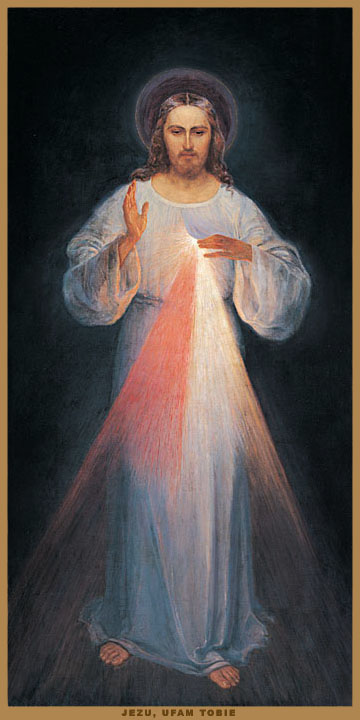
(artwork Christ's appearance to the Apostles, by Andrey Mironov CC BY-SA 3.0 via wikimedia commons;  Jesus, I Trust in You, by Eugeniusz Kazimirowski  public domain via wikimedia commons)

Sunday, April 21, 2013

My Sheep Hear My Voice.


A reflection on the readings for the Fourth Sunday of Easter, 2013


Thereadings this Sunday call us to martyrdom; to witness in strength and love to the Lamb who shepherds us and fills us with His joy.  How do we gain the confidence of Paul and Barnabas to be a witness to the truth of the Gospel?
 
John: 10:27-30
Jesus said:  “My sheep hear my voice; I know them, and they follow me.  I give them eternal life, and they shall never perish.  No one can take them out of my hand.  My Father, who has given them to me, is greater than all, and no one can take them out of the Father’s hand.  The Father and I are one.”


By, Luke Knofczynski
 Luke's drawing of him listening to Jesus
Do you know His voice?  How do you learn to hear his voice?  These were questions that came up in our recent Kyrion meeting.  Kyrion is a prayer group for children that we have at our parish.   We are a small group under the umbrella of One Heart~One Fire.  The format for our small but faithful group starts with praise of God in song, an opening prayer, then we read, discuss, act out, meditate and journal on the Gospel for the upcoming Sunday.  We end with prayer.  We are trying to ignite a love for the Father in the hearts of the children, and to lead their hearts to know His voice.  And we are faithful and obedient to the teachings of our Church.  She is our guide into the heart of Christ.  Yet, it is a tall order.  There is an initial discomfort among all the children.  Jesus sometimes says strange things, challenging things.  It may be easier to keep a safe distance.   Even the children perceive this and our culture encourages it.

And this stirs up a bit of nervousness.  Truly, If you were to walk into our room in the middle of one of our meetings you would see what may look like chaos, in fact, it often feels like chaos to me (especially if I happened to have my toddler, Max, along).  To our eyes the rambunctious children do not seem to be ready or able listen and hear the Word of the Lord.  But our eyes miss a lot.   It is hard to perceive the very small movements of God in the ordinary messiness of our daily lives.

After my first few, very, very, VERY noisy and rowdy Kyrion meetings this year, I was tempted to give in to the feeling that it really was not worth the effort on a Friday afternoon, when I would much rather go home and relax with my family after a long week.  After all, we went to Mass that day, we will pray our nightly decade of the Rosary with the children before they go to bed…what more do we need to do?  Yes, Mass and devotion to our Blessed Mother are foundational to this ministry, but God has shown me, through many different means, how dangerous the attitude of "I have done enough" can be.  It can seduce you to compartmentalize faith.  It can induce a complacency in our soul and - I think we can see this in our culture - this complacency reduces our ability to love others with the passionate and fiery love of Christ; with a love that witnesses His love.  We will become lukewarm.  We will not be able to perceive evil, we will be easily deceived and truth will be inverted.  Thus I persevere with our other families. I have learned, over the course of the years how much He can do with a little perseverance on my part.  I am learning to notice the still,  small movements of His Spirit which reveal that the sheep are listening.
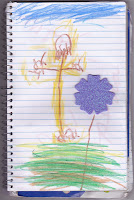
By: Sophia Knofczynski
Sophia's drawing of Jesus
In fact, on many Sundays, when the Gospel is read at Mass (or during the children’s liturgy he sometimes attends) my son Luke will comment on how we read that in Kyrion, or how he got to play the part of Jesus in that Gospel during Kyrion, or how he drew a picture of Jesus when we journaled on the Gospel.  He is engaged in the readings at Mass in a way that he would not otherwise be.  He is given permission to understand that the Word of God is written for him.  This is not selfish, it is learning to recognize the voice of the Lamb, the shepherd of His people.  In fact, it is giving him the courage to respond to His word in a way that will witness to others.   And he will need the courage; our children will need to know the voice of Jesus.  For some form of martyrdom awaits all of us who listen to and obey the shepherd’s voice, but we are assured that even if we suffer for His sake in this world the Father will not allow you to be lost.

I, John, had a vision of a great multitude, which no one could count, from every nation, race people, and tongue.  They stood before the throne and before the Lamb, wearing white robes and holding palm branches in their hands.  Then one of the elders said to me, “These are the ones who have survived the time of great distress; they have washed their robes in the blood of the Lamb.  “For this reason they stand before God’s temple.  The one who sits on the throne will shelter them.  They will not hunger or thirst anymore, nor will the sun or any heat strike them.  For the Lamb who is in the center of the throne will shepherd them and lead them to springs of life-giving water, and God will wipe away every tear from their eyes.”  Rev 7:9, 14 B-17

So it is imperative that we learn to hear His voice!  We need to teach our children that He is always speaking to us.  In our meeting, we ran a simple game with our children.  They were each blindfolded, and we (their mothers) scattered around the room and all called to them.  They had to listen and discern where their parent was.  They all succeeded.  Why?  Because they live with us, because they communicate with us.  They have learned to know our voices for their own safety, and for their individual needs for nurturing and love.  We learn to hear His voice by living with Him every day, in His Word, in prayer, by frequently coming to Him in adoration, in the Sacraments, in repentance.   Do you know His voice?  You must or you will be lead astray. You must know His voice and be prepared;  because sometimes He asks His followers to do hard things.  To love impossible people.  To forgive unspeakable crimes.  To proclaim Him in terrifying situations.  But in Him you can endure times of great distress, and confidently rejoice that your will be worthy of everlasting life where God Himself will wipe away every tear.

We are His people the sheep of His flock!  Amen!  Alleluia!

Heidi 

Tuesday, October 4, 2011

Martyr/Martyrdom, by Mary Dwyer


Originally the word martyr meant witness.  The word “martyr,” from the Greek martus, literally means “a witness who testifies to a fact of which he has knowledge from personal observation.  The definition was used both in the secular world as well as in the Old and New Testament of the Bible.  (Trites) The process of bearing witness was not intended to lead to the death of the witness, although it is known from ancient writers [Josephus] that witnesses, especially of the lower classes, were tortured routinely before being interrogated as a means of forcing them to disclose the truth. (Wikipedia)
Most scholars consider the Hasmonean traditions preserved in Maccabees as representing the earliest Jewish strata of martyrology.  A definition of martyrdom that includes:

  1.     public declaration of one’s allegiance to God and Torah in the face of official demands to betray that allegiance or die;
  2. .      the perception that this act fulfills a religious mandate (that death is what God demands when the alternative is apostasy);
  3. .      the passionate commitment of the adherent to both God and Torah;
  4. .      these deaths serve a larger redemptive purpose, generally for Israel as a whole; AND
  5. .      death [or near death experience of Isaac—as interpreted later—or Daniel]. (Lander)
 Jesus spoke of the time “from the blood of Abel to the blood of Zachariah” [Lk. 11:51; Matt. 23:35] when referring to the martyrs of the Old Testament.  Since Chronicles is the last book in the Hebrew Bible, Jesus was making a comprehensive statement covering the known Old Testament [Genesis—Chronicles].  (Vlach)
During the early Christian centuries, the term acquired the extended meaning of a believer who is called to witness for their religious belief, and on account of this witness, endures suffering and/or death. The death of a martyr or the value attributed to it is called martyrdom. (Wikipedia)   
The Catholic ideal of martyrdom is found in Christ’s words of the Gospel: “Whoever finds his life will lose it, and whoever loses his life for my sake will find it.” [Mt 10:39]. (Curley)  Eventually the term “Christian martyr” became associated only with those who witnessed to Christ with their blood. (Encyclopedia) 

An example of Martyrs found in the Old Testament in which the witnesses did not die is the story of the three young men put into the fiery furnace by the Babylonian King Nebuchadnezzar.  “He ordered the furnace to be heated seven times more than usual and had some of the strongest men in his army bind Shadrach, Meshach, and Abednego and cast them into the white-hot furnace. [Daniel 3:19-20] Their belief in God saved them.
The Maccabees martyr stories are probably the most well know of the Old Testament.  Because these books are found in the Septuagint and Deuterocanonical I think it is important to provide some information on the split between Jews and Catholics about the Maccabees books.  Lander’s writes that there is evidence in both Josephus and in the writings of fourth century church fathers that the Jews of Modin and Antioch revered the Maccabees martyrs at their tombs. That Jews at Antioch built a shrine which purportedly contained the bones of the Maccabees mother of the seven sons. Jews as well as Christians would visit this shrine seeking healing and other miracles, an intermingling evidenced at the shrines of other Biblical sites in the Greek east. 
What changed over the years creating the split on the tradition to the Maccabean Martyrs?  Landers noted that as Jewish and Christian identity became increasingly defined holy places became sites of contestation.  As Christians laid increasing claim to martyrs, martyrdom, and martyrologies, not to mention the frequency with which early Christian exegetes portrayed the Maccabean martyrs in particular as Jewish prefigurations of Jesus, Jews were less motivated to preserve these accounts as their own. Lander believes this is one of the reasons for the exclusion of the books of Maccabees from the Hebrew Bible.
The Maccabean Martyr stories express instances of martyrdom where citizens flaunting the restrictive religious measures imposed by King Antiochus Epiphanes.  These are witnesses who die for their religious belief and love of God.  Somewhat less well-know are the families massacred in witness to the law and to the Sabbath. First, those pursued and confronted by the officers and soldiers of the king into the desert “They said, ‘Let us all die without reproach; heaven and earth are our witnesses that you destroy us unjustly.’" [1 Mc 2:37].  Second there are the two mothers and their circumcised infants who are hurled from the city walls in public view. And third a group of secret Sabbath-observers are burned to death. [2 Mc 6:10-11].
More familiar are the martyrdoms of the elder scribe Eleazar and those of the pious mother and her seven sons. These witness stories are about observance of the law and the power of love for God.  The officials ask Eleazar to eat pork or to pretend to eat pork by eating his own legitimately [allowed by the Torah] meat. [2 Mc 6:21].  Eleazar defies the order and declares, “I will show myself worthy of my old age and set a noble example for the young of how to die a good death willingly and nobly for the revered and holy laws.” [2 Mc 6.27-8]
A second, more famous, story is the martyrdom of the mother and her seven sons. King Antiochus is the oppressor.  He brutally tortures each son in front of their mother and a large crowd. This story also connects to the promise of a life after death and therefore use by Catholic to demonstrate Jesus’s message of losing one’s life to gain life.  It is the testimony of the second son which first connects the death of martyrs to the promise of their resurrection, a claim repeated in the third and fourth son: “You accursed fiend, you are depriving us of this present life, but the King of the world will raise us up to live again forever. It is for his laws that we are dying.” [2 Mc 7:9].
The fourth brother declares" It is my choice to die at the hands of men with the God-given hope of being restored to life by him; but for you, there will be no resurrection to life." firmly believing in God's promise of life. [2Mc 7:14]   (Hoagland)
Finally as Landers writes the mother is revered as a model of courage and faith, as she implores her children to resist the imperial demands for apostasy. The seventh son heeds her advice, proclaiming at his death, “I will not obey the king's command. I obey the command of the law given to our forefathers through Moses. [2 Mc 7:30].”

Copyright 2011, Mary Dwyer

Bibliography

Catholic Encyclopedia. 1917. Print.
Curley, Jim. "The Catholic Ideal of Martyrdom." Catholic Men’s Quarterly Spring 2005. Web.
Hoagland C.P., Victor. "On Martyrdom: Ignatius of Antioch and Bishop Bossilkov." Bread on the Waters Web Pages. Web. <http://www.cptryon.org/cpexams/bossilkov/vhcp.html>.
Lander, Shira. "Martyrdom in Jewish Traditions." Catholic-Jewish Consultation Committee Meeting. St. Mary’s Seminary, Baltimore, MD. 11 Dec. 2003. Web. <http://www.bc.edu/research/cjl/meta-elements/texts/cjrelations/resources/articles/Lander_martyrdom/index.html>.
"Martyr." Wikipedia, the Free Encyclopedia. Web. <http://en.wikipedia.org/wiki/Martyr>.
The New American Bible. United States Conference of Catholic Bishops, 2002. Web. <http://www.usccb.org/nab/bible/index.shtml>
Trites, Alison. "MartyrThe New Testament Concept of Witness." Wikipedia, the Free Encyclopedia. Web. <http://en.wikipedia.org/wiki/Martyr>.
Vlach, Michael J. "How Did the Old Testament Become the Old Testament?" TheologicalStudies.org. Web. <http://www.theologicalstudies.org/page/page/1572454.htm>.