Welcome !

Greetings to all who love to wander along the paths of the Holy Scriptures! The purpose of this blog is to share some of the insights of ordinary Catholics who have begun to delve into the mysteries of the Sacred Scriptures. Hopefully you will find these reflections inspiring and insightful. We are faithful to the Church, but we are not theologians; we intend and trust that our individual reflections will remain within the inspired traditions of the Church. (If you note otherwise please let me know!) Discussion and comments are welcome, but always in charity and respect! Come and join us as we ponder the Sacred Scriptures, which will lead us on the path into His heart, which "God alone has traced" Job 28:23.
Showing posts with label Pope Benedict. Show all posts

Saturday, September 6, 2014

Blessed are Those Who Mourn!

A Reflection on Ezekiel 33:7-9 N.A.B.

By: Larry T

7 You, son of man, I have appointed watchman for the house of Israel; when you hear me say anything, you shall warn them for me.
8 If I tell the wicked man that he shall surely die, and you do not speak out to dissuade the wicked man from his way, he [the wicked man] shall die for his guilt, but I will hold you responsible for his death.
9 But if you warn the wicked man, trying to turn him from his way, and he refuses to turn from his way, he shall die for his guilt, but you shall save yourself.
- Ezekiel 33:7-9 N.A.B.

God called Ezekiel to the thankless and dangerous task of preaching to a society that had hardened their hearts against Him. It was a message that the people and their leaders didn’t want to hear; it called them back to God’s unchanged covenant. Old Testament prophets were usually met with misunderstanding, derision and rejection by the general populace and Ezekiel was not an exception.

We may not be biblical prophets, but we are anointed priests, prophets, and kings though baptism.

1241 The anointing with sacred chrism, perfumed oil consecrated by the bishop, signifies the gift of the Holy Spirit to the newly baptized, who has become a Christian, that is, one “anointed” by the Holy Spirit, incorporated into Christ who is anointed priest, prophet, and king. – Catechism of the Catholic Church

God calls all baptized Christians to the prophetic task of being mourners. In Matthew’s gospel the second beatitude is: “Blessed are those who mourn, for they shall be comforted.” What does that really mean? “The mourning of which the Lord speaks is nonconformity with evil; it is a way of resisting models of behavior that the individual is pressured to accept because ‘everyone does it.’ The world cannot tolerate this kind of resistance; it demands conformity. It considers this mourning to be an accusation directed against the numbing of consciences. And so it is. That is why those who mourn suffer persecution for the sake of righteousness.” says Pope Benedict XVI in his book Jesus of Nazareth.

God’s orders for Ezekiel were typically something like, “Son of man, make known to Jerusalem her abominations.” What are God’s orders for us? If we are to discern which models of behavior to resist we need a degree of wisdom.

The Serenity Prayer is the common name for a prayer authored by the American theologian Reinhold Niebuhr (1892–1971). The best-known form is:

God, grant me the serenity to accept the things I cannot change,
the courage to change the things I can,
and the wisdom to know the difference.

Some things will never change. For example, when taking a shower, it is always going to be better if the shower curtain is on the inside of the bathtub instead of on the outside – that will never change. Countless people can try to convince us that the shower curtain should go on the outside of the bathtub, but we know better. So the ability to recognize when something can’t change in the face of a society that says it is can change is wisdom of a different sort. Today a seemingly large part of society is trying to convince us that God’s laws are changeable, but we know better. 

Ezekiel fulfilled his prophetic mission by doggedly carrying out God’s instructions. One way that we can fulfill our prophetic calling is by refusing to cave into societal pressure to accept models of behavior that are clearly against God’s laws, and to live our lives as God’s people with the understanding that we too will sometimes be met with rejection and derision.

Saturday, February 16, 2013

The First Sunday of Lent: Temptation in the Desert


I love Pope Benedict!  I love his books on Jesus of Nazareth.  It is in my reading of His first book in the series (from the baptism in the Jordan to the Transfiguration) that I have based this reflection on, and the quotes were taken from that book.

On the First Sunday of Lent we read in the Gospel of Luke of how Jesus was led into the desert for forty days to be tempted by the devil.

Filled with the Holy Spirit, Jesus returned from the Jordan and was led by the Spirit into the desert for forty days, to be tempted by the devil.  He ate nothing during those days, and when they were over he was hungry.  The devil said to him, “If you are the Son of God, command this stone to become bread.”  Jesus answered him, “It is written, ‘One does not live on bread alone’.”  Then he took him up and showed him all the kingdoms of the world in a single instant.  The devil said to him, “I shall give to you all this power and glory; for it has been handed over to me and I may give it to whomever I wish.  All this will be yours, if you worship me.”  Jesus said to him in reply, “It is written: ‘You shall worship the Lord, you God, and him alone shall you serve.’”  Then he led him to Jerusalem, made him stand on the parapet of the temple, and said to him, “If you are the Son of God, throw yourself down from here, for it is written:  ‘He will command his angels concerning you, to guard you’, and:  ‘With their hands they will support you, lest you dash your foot against a stone.’”  Jesus said to him in reply, “It also says, “You shall not put the Lord, your God, to the test.”  When the devil had finished every temptation he departed from him for a time.”  Luke 4:1-13

What is the central temptation here?  Pope Benedict XVI states that it is the temptation to “push God aside as secondary, if not actually superfluous and annoying, in comparison with all the apparently far more urgent matters that fill our lives.”(pg. 28)   We are tempted to see the realities of our world as more real than our relationship with God.  And this puts all of our actions on a shaky foundation, disordering even out best intentions.
 
With this in mind I remember a time when I was driving home from church with my son Stephen and we ended up behind someone with the bumper sticker: Coexist.  Nice, it sounds good and accepting…except in my opinion, it is one of the most disingenuous bumper stickers out there.  It is a devilish trick indeed to appeal to our natural desire for unity, and to do it by making faith take a back seat to the goal of unity.  The other bumper sticker on this young lady’s car proved my sense to be true.  It said:  “While you are at church, I am out doing good things.”  So, in fact, Coexist is not some statement about being kind and accepting of different creeds, but a statement that religion, in general, and Christianity specifically, is just one big childish distraction that needs the “real world” grownups to admonish them to all play nice and get along so that good things can be done.
 
The feeling that faith in God is superfluous to serving mankind is a growing attitude.  And even among practicing Christians the temptation to pull bits of Scripture out of the Bible and separate it from its source (GOD!) is strong. (And to be fair to Coexist, her philosophy becomes all the more acceptable because of this.)  However, this undermines the strength of our faith and thus the strength of our compassion. If you think that keeping the lines about feeding the hungry and clothing the naked from the Bible is fine, but don’t care if we lose those passages about loving the Lord your God with all your heart, mind and strength, especially when loving God is equated with following His commands, you are not terribly far off from Coexist’s take that faith and worship undermine good works. Is this not the temptation to push aside faith and worship for more “real” concerns?

The reality is quite the opposite, as we see with Jesus in His temptations.  When Jesus goes into the desert He does so in obedience to the Spirit, in a continuation of His baptism.  He enters into a time of intensive prayer and fasting in which He seeks to draw His strength and His love from the Father.  Now He enters into our temptations to push God away.  These temptations to push God away crop up for a number of reasons; because we can’t fix everything, because we suffer and others also suffer, because we desire to be in control of our own destinies and be assured that all will be well.  Jesus endures His temptation under great physical stress, He shares, in a way, our weaknesses.  He is showing me that my only hope in resisting “the delusions of false philosophies” is to recognize that we do not live by bread alone, “but first and foremost by obedience to God’s word.” (pg. 34)  An obedience that leads to the love of God abiding in me.  “Whoever keeps his word, the love of God is truly perfected in him. This is the way we may know that we are in union with him.”  1 Jn 2:5

I can imagine very good reasons for giving into the temptations that are presented to Jesus; taking care of bodily needs is good, having a just man in power is good, being able to have faith in the Lord’s protection is good.  But in all these actions the devil is tempting Jesus (and me, every day in some way) to become my own god, to decide for myself what God would do, and to demand that He do it. The devil does not want me to submit my desires and actions to prayer and to the commandments first.  He does not want me to grow trust in Him through times of suffering.  He does not want me to learn to know the Lord, through prayer, though His living word and through obedience to His commands.  He wants me to relativize His word, so it is abstract, distant and His commandments are malleable.
    
If we do not really take to heart what Christ is doing when He refuses to turn a stone into bread to feed what must have been a profound hunger, when He refuses to assume earthly political power, or when He refuses to put God to the test, we also are at risk for allowing the reality of God, and of His Son recede into the abstract.  And with our faith simply an idea or a concept, we are susceptible to the tyranny of moral relativism, which saps our moral strength.  And when we lose our moral strength the good that we seek to do becomes perverted into something that in the end is so much more harmful.  This is where we become enslaved to “compassionate solutions” like abortion for unwanted pregnancies….because we do not have the moral fortitude to teach virtue.  Because we do not have the enduring love of God in us to help us to suffer with and through these situations, which are often messy and painful all the way around.
   
We cannot love and serve or even coexist with others with the supernatural strength it takes in this world without the love of God in our hearts.  And it is in prayerful listening and obeying God's commands that leads to a relationship with him which places His love in our hearts.    When we can act with that foundation of love, we can truly serve the “urgent matters” that present themselves with true integrity and authentic compassion.  It is not easy to resist the temptation to push God to the side, let us all pray for one another to keep God at the center of all that we do.

Peace and Grace of Christ to all!
Heidi  


Friday, December 7, 2012

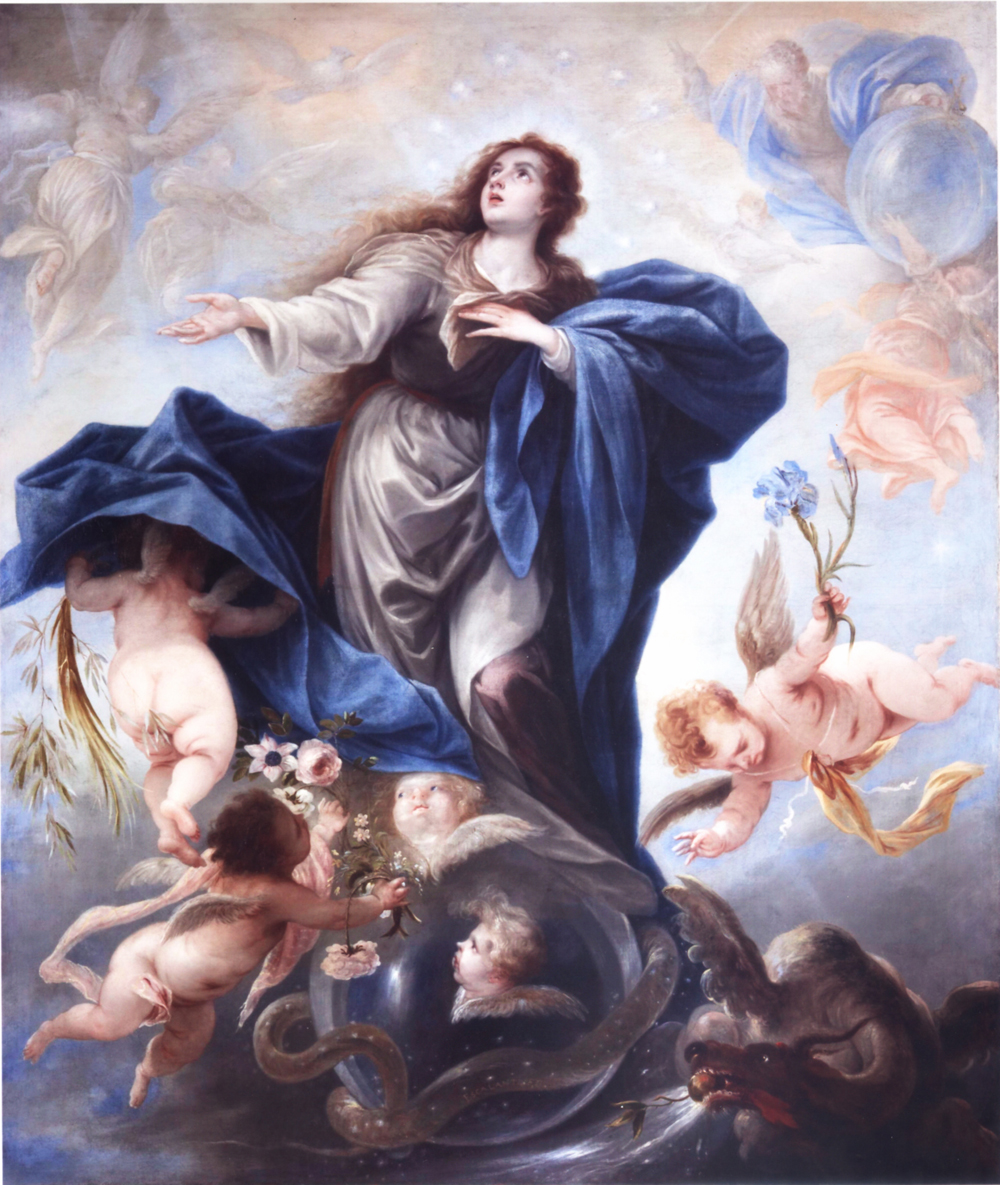
Of His Most Astounding Mercy, and Her Most Immaculate Beauty!


I love the Solemnity of the Immaculate Conception!

The readings for this Solemnity start with the Genesis story which contains what we are taught is the Protoevangelium:  The first announcement of the Messiah Redeemer.

I will put enmity between you and the woman, and between your offspring and hers; he will strike at your head, while you strike at his heel."  Gen: 3:15

In this passage we are shown that even at the moment of our most profound failures the God of the universe never abandons us.    He never gives up on us. NEVER!  It is also a passage which did not yeild its full significance until the Gospel of Christ is revealed to us. I have linked you to a John Paul the Great general audience on The Protoevangelium of Salvation, I highly encourage you to read it!  Here is a snippet:

The analysis of the "protoevangelium" informs us, by means of the announcement and promise contained in it, that God has not abandoned the human race to the power of sin and death. He wished to rescue and save it. He did so in his own way, according to the measure of his transcendent holiness, and at the same time according to a self-effacement such as only a God of love could display."

I think that the line "according to the measure of his transcendent holiness, and at the same time according to a self-effacement such as only a God of love could display." are tremendous words to ponder, and especially in light of His great gift to us of the Blessed Mother!  Those words are referring to Christ's obedient sacrifice, in which Adam's sin is undone, but that sacrifice is also reflected in the obedient fiat of Mary, who was the chosen woman to reverse the disobedience of Eve.  In my more reflective moments, I cannot fathom our God's self-effacement. God, whose power and might are so great that Moses cannot look upon His face and live, yet He wills to be born into this world of a woman, so as to lift up womanhood, in fact, motherhood (and ultimately all of redeemed humanity) to a high beauty and magnificence that cannot be contained in this world.  He then gives this woman to us to be our mother as well, and in all this she gives her total "fiat".  

Just contemplating Mary reduces me to a puddle of emotion, and I am not an emotional person, but the gift of Mary as my mother touches me - and mystifies me profoundly! Only a God of unfathomable tender mercy would know that our hardened hearts cannot withstand the love of a mother, a mother who freely, with unrestrained love and complete trust in God said yes to the Incarnation and all the sacrifice, suffering (and yes, also joy) that came with it.  She entrusted her whole self to Him in order for God's salvation for each of us to be fulfilled.

Consider this passage from Pope Benedict XVI's newest book:  Jesus of Nazareth, The Infancy Narratives, as our Pope reflects on the moments after the angel Gabriel has departed from her, and of the great reserves of faith that she was gifted with in her Immaculate heart:

The great hour of Mary's encounter with God's messenger - in which her whole life is changed - comes to an end, and she remains there alone, with a task that truly surpasses all human capacity.  There are no angels standing round her.  She must continue on the path that leads through many dark moments - from Josephs's dismay at her pregnancy to the moment when Jesus is said to be out of His mind (cf Mk 3:21;Jn 10:20), right up to the night of the cross.
How often in these situations must Mary have returned inwardly  to the hour  when God 's angel had spoken to her, pondering afresh the greeting: "Rejoice, full of grace!" and the consoling words: "Do not be afraid!"  The angel departs; her mission remains, and with it matures her inner closeness to God, a closeness that in her heart she is able to see and touch,". (Pg 37 -38)

Her task was unbelievable, at times unendurable, yet she believed and endured, because she knew His love, and as our Mother she intercedes for each of us that we may be filled with that love also. She is a Our Lady, Our Mother and there is no beauty in this world, or the next, that can exceed hers.  And the Father's using her in His plan of Salvation is also a reflection on how complete His redemption of us will be.  Let me put up another passage from Pope John Paul's general audience text:

"The Father of mercies willed that the Incarnation should be preceded by the acceptance of her who was predestined to be the mother of his Son, so that just as a woman contributed to death, so also a woman should contribute to life. That is true in outstanding fashion of the mother of Jesus, who gave to the world him who is Life itself and who renews all things, and who was enriched by God with the gifts which befit such a role. It is no wonder therefore that the usage prevailed among the Fathers whereby they called the mother of God entirely holy and free from all stain of sin, as though fashioned by the Holy Spirit and formed as a new creature. Adorned from the first instant of her conception with the radiance of an entirely unique holiness, the Virgin of Nazareth is greeted, on God's command, by an angel messenger as 'full of grace,' and to the heavenly messenger she replies: 'Behold the handmaid of the Lord, be it done unto me according to your word.' Thus Mary, a daughter of Adam, consenting to the divine Word, became the mother of Jesus, the one and only Mediator. Embracing God's salvific will with a full heart and impeded by no sin, she devoted herself totally as a handmaid of the Lord to the person and work of her Son, under him and with him, by the grace of almighty God, serving the mystery of redemption" (LG 56). 
Thus in Mary and through Mary the situation of humanity and of the world has been reversed, and they have in some way re-entered the splendor of the morning of creation.

Joy!  Just think of what God has given us in Mary, just think of what it means for you and me who are individuals mired in our sinfulness, in our disordered desires and in our fears.  I believe it means that -with our daily Fiat, and our daily repentance -  our redemption will not only be a wiping out of even our worst sins,  but a complete reversal of all that enslaves us.  What ever sin that tempts you and makes you cringe in shame about yourself, will, when you give it to Him, with faith and in due time, be sanctified and reordered to serve God.  Trust Him as Mary did!  If your worst sin is cowardice, God will bring about in you a reversal and He will allow you opportunities to become courageous and bold for Him.  If it is lust, God will draw out from you the truest, most pure, devoted and passionate love of Him and of all His creation in it's beauty and power.  What astounding mercy!  What an awesome gift! But your daily repentance and your daily fiat and also your daily endurance in faith, modeled after Mary, is needed.  And Mary, in her Immaculate Conception and in her radiant and unique holiness, is the model, par excellence, of Christ's words to us in Revelation:  "Behold, I make all things new." 

Hail Mary, full of grace!
The Lord is with you!
Blessed are you among women,
and blessed is the fruit of your womb Jesus.
Holy Mary, Mother of God 
Pray for us sinners,
now and at the hour of our death.
Amen


Click here for a reflection on the same passage in Pope Benedict's Jesus of Nazareth by the most awesome Monsignor Pope

Tuesday, October 16, 2012

Platitudes or Blood, Water and the Spirit (revised)

Since we have not posted anything yet this month, and I have some posts in the works but not complete, I am re-posting an earlier reflection.  But we have exciting news:  Look for a new contributor to our blog to be posting this weekend.  Larry T. has recently joined us and we are blessed to have him!


Beloved:  Everyone who believes that Jesus is the Christ is begotten by God, and everyone who loves the Father loves also the one begotten by him.  In this way we know that we love the children of God when we love God and obey his commandments.  For the love of God is this, that we keep his commandments and his commandments are not burdensome, for whoever is begotten by God conquers the world.  And the victory that conquers the world is our faith.  Who indeed is the victor over the world but the one who believes that Jesus is the Son of God? 
This is the one who came through water and blood, Jesus Christ, not by water alone, but by water and blood.  The Spirit is the one that testifies, and the Spirit is truth. 1 John 5:1-6


Pope Benedict XVI in his book Jesus of Nazareth explains verses 6-8, the verses about water and blood and Spirit this way:

  "Here John very obviously gives the motif (of blood and water) a polemical turn against a form of Christianity that acknowledges Jesus' Baptism as a saving event but does not acknowledge his death on the Cross in the same way.  He is responding to a form of Christianity that, so to speak wants only the word, but not the flesh and blood.  Jesus' body and his death ultimately play no role.  So all that is left of Christianity is mere "water"-without Jesus' bodiliness the word loses its power.  Christianity becomes mere doctrine, mere moralism, and intellectual affair, but lacks any flesh and blood."


Saint John is speaking about Christians who want to be saved, but not by the flesh and blood offering of Jesus in His redemptive death on the cross, but by baptism alone. They wanted the water, but not the blood. And without the water and blood, both, in our daily lives and in Church we are reduced to mere moralists.  In our current day, because we are fast loosing our belief in objective morality (the Commandments) we are often the most tyrannical of moralist:  moralists with no moral grounding!

This brings me to a Facebook debate, and a particularly unpleasant one at that. Most of the participants claim to be Catholic, however one side, which was the side claiming to be for Christian love and tolerance, was defending a rather vile post which featured a picture of a bishop with the word bigot scrawled across it, the other (the side I was "liking") was asking for justification for this slanderous and unkind post. We received no justification, only over-generalized reasons for disdain of the Catholic hierarchy and Catholic moral teachings and, of course, the standard Jesus platitudes were stated and restated. Calling a bishop a bigot was rationalized and defending him (which we were doing) was: "casting stones".  Defending church teaching called for an angry tirade about how we should "remove the beam from our own eyes!"  We "were not loving our neighbor as ourselves", so on and so on....My Facebook encounter left me sad because I saw abstracted faith, that was highly moralistic but not at all grounded in authentic love or objective morality.  Anyone who rejected this was treated to a barrage of words; quotes from Jesus thrown at them like the stones.  I was sad because the Jesus they were quoting was so weak, so hollow, so lacking in power and majesty.  He was a one dimensional preacher, not the Incarnate Word.

 How can anything that the Alpha-Omega, Eternal Son of the Living God, Victor over the Universe and all powers of darkness be so banal and lifeless?  The answer:  When you remove Him from the deep and profound immutable Truths that the Lord God revealed to the Children of Israel and her prophets. Then, the summation of the law:  Love God above all and love your neighbor as yourself, becomes so malleable that they essentially mean whatever the follower wants it to mean.  Or, as in our debate, only the love of neighbor was acknowledged, not the love of God with your whole heart, mind and soul, not to mention the fact that you love them both by following the Commandments.

You can see that the biggest problem with the Jesus platitudes that were being used against us is that they are removed from the flesh and blood Jesus, and the whole of divine revelation, from the beginning of Genesis to the end of Revelations. Therefore they reduce His power to mere ideas; concepts of morality.  With the Word made Flesh thus abstracted,  these words are trivialized and relativized.  Water without flesh and blood.

In the reading above, Saint John reaches far beyond platitudes in calling us to love, he calls us to a living relationship with Jesus who was crucified for us.  He first speaks of belief in Jesus, the Christ, and then of obedience to the commandments. This obedience is empowered by His love in us, which we receive in faith and which we nourish through our reception of the sacraments.  He conquers our worldliness through our daily acts of faith and love. The last passage grounds our relationship with Jesus in His flesh and blood, not merely abstract words and platitudes. We are united by our baptism with the One who loved us so passionately that He poured out His blood from His pierced heart for each one of us, and in turn we are drawn into this great love and pour out our flesh and blood for Him and for others in the Spirit of Truth.

This is not an abstract concept of truth or morality, but a struggle - an epic struggle to submit our fleshly desires, which we are all too willing to separate out from our spirituality, to the Spirit of Truth.  Because our desires ought to orient us to union with Christ. When we continue to separate our flesh and blood desires from the Spirit of Truth we are blinded from discovering the One are hearts most ardently desire.  And with such inborn passion for Him, we cannot simply seek Him in concept, but in His flesh and blood, crucified and resurrected.  This takes daily prayer, and  reading of Scripture and listening for His voice.  It takes sacrifice and sacraments.  It takes a willingness to love and be loved by Christ, not that one dimensional spiritual teacher but the Beloved, the Eternal Flame which burns but never consumes, the Pillar of Fire, the Still Small Voice, the Thundering Theophany carving His law into stone and then on Calvary pouring out his Spirit to place it in our hearts. He is the Divine lover, and in Him all things are fulfilled.  And to the extent we can allow the Spirit to testify to these truths through us, we will be able to love our neighbor with His love, and not with our platitudes.

Peace and Grace
Heidi

Saturday, April 14, 2012

Platitudes or Water, Blood and The Spirit

Beloved:  Everyone who believes that Jesus is the Christ is begotten by God, and everyone who loves the Father loves also the one begotten by him.  In this way we know that we love the children of God when we love God and obey his commandments.  For the love of God is this, that we keep his commandments and his commandments are not burdensome, for whoever is begotten by God conquers the world.  And the victory that conquers the world is our faith.  Who indeed is the victor over the world but the one who believes that Jesus is the Son of God? 
This is the one who came through water and blood, Jesus Christ, not by water alone, but by water and blood.  The Spirit is the one that testifies, and the Spirit is truth. 1 John 5:1-6

I have recently participated in a Facebook debate, and this one was particularly unpleasant, one side claiming to be on the side of love and tolerance, the other (the side I was "liking") was asking for justification for abusive and slanderous posts that included an inflammatory picture of the a bishop with the word bigot scrawled across it.  We received no justification, only over-generalized reasons for disdain of the Catholic hierarchy and Catholic moral teachings and, of course, the standard Jesus platitudes were stated and restated. Calling a bishop a bigot was rationalized and defending him called sown an angry tirade of how we were: "casting stones"and how we should "remove the beam from our own eyes!"   It was ugly and it was sad.  Love was diminished to complacent acceptance, if you did not accept what they accepted you were of course, rejected.

What do I mean by a Jesus platitude?  A platitude is a statement , supposedly profound, but in reality it is flat, dull and banal.  How can anything that the Alpha-Omega, Eternal son of the Living God, victor over the universe and all powers of darkness be banal and trite?  The answer:  When you remove it from the deep and profound Truths that the Lord God revealed to the Children of Israel and her prophets.  Then, the summation of the law:  Love God above all and love your neighbor as yourself, becomes so malleable that it essentially means whatever the follower wants it to mean.  So, the biggest problem with Jesus platitudes is they stifle the power of Jesus' love by reducing His power to mere words; then they trivialize and relativize it.  In a way, they inoculate you against the transformitive love of Christ.   Now, His love merely accepts you, it does not transform or reform you.   Since we are truly made for higher pleasures - we have much more heroic ambitions and deeper desires of which platitudes only superficially address - and are often used to excuse the misdirection of these ambitions and desires -  this can only lead to shallow love and ultimately to angry despair. Because despite all of your efforts to live a life that is worth living, without being begotten by God you will not even be able to live up to the platitudes.  There is no way to live an integral moral life with such great desires, so many earthly pleasures and this banal version of the Lord.

So when I read the second reading, especially grounded in the rest of this Sunday's readings, I see a much fuller picture of how the love of Jesus transforms, and of how it is nourished and inflamed and regenerated in the sacraments of the Church.  He first speaks of belief in Jesus, and then of obedience to the commandments, obedience that is empowered by His love in us.  The last passage grounds our relationship with Jesus in his flesh and blood, not merely words and platitudes, but as a man who loved us so passionately that He poured out his blood from his pierced heart for each one of us.

Pope Benedict XVI in his book Jesus of Nazareth explains verses 6-8, the verses about water and blood and Spirit this way:

  "Here John very obviously gives the motif (of blood and water) a polemical turn against a form of Christianity that acknowledges Jesus' Baptism as a saving event but does not acknowledge his death on the Cross in the same way.  He is responding to a form of Christianity that, so to speak wants only the word, but not the flesh and blood.  Jesus' body and his death ultimately play no role.  So all that is left of Christianity is mere "water"-without Jesus' bodiliness the word loses its power.  Christianity becomes mere doctrine, mere moralism, and intellectual affair, but lacks any flesh and blood."
My Facebook encounter left me sad because I saw an intellectualized faith, that was really highly moralistic but not at all grounded in authentic love or objective morality, thus all the moralizing was to affirm others in being possessed by their passions instead of seeking the One to whom those passions point to.  Anyone who rejected this was treated to a barrage of words; quotes from Jesus thrown at them like the stones.   Yet, in a true encounter with  Christ your passions, your love and your desires will begin to be reordered to their true purpose.  It is impossible without Christ, but as you fall deeper in love with the Jesus -  the authentic Jesus who is flesh and blood, strength and power - you will find that His Passion is reforming yours.

If that sounds too ethereal, I can assure you that it is not.  But it takes daily prayer, and Scripture.  It takes sacrifice and sacraments.  It takes a willingness to look to Christ not as a one dimensional moral and spiritual teacher, but as the Beloved, the Eternal Flame which burns but never consumes, the pillar of fire, the still small voice, the thunderous theophany carving His law into stone and then on Calvary pouring out his Spirit into out hearts. He is the Divine lover, and in Him all things are fulfilled.  The depth of love that you are willing to enter into with Him will not be burdensome, when you love some one deeply wellsprings of strength and courage build up and you will live a life that has much more to offer than mere platitudes.

Peace and Grace
Heidi

BTW, if you have time Monsignor Pope's latest article is not to be missed!

Thursday, February 2, 2012

Scripture and the Events of My Life


One of the reasons a few of us worked to establish this blog site was so that we could continue to share in each other's reflections on scripture.

Again, we want to encourage all readers of our Journey to Wisdom site to share your stories—how your holy reading and study of scripture helps you connect God's word to your everyday life experience. 

 “We too must be capable of bringing before God our struggles, the suffering of certain situations, of certain days, the daily undertaking of following him, of being Christians, and also the weight of evil that we see without ourselves and around us, so that he may give us hope, that he may make us feel his closeness and give us a light on the path of life.” (Pope Benedict XI, general audience address, February 1, 2012).

I know of no more effective way of bringing my struggles before God than in prayerful reading of scripture passages. The combination of Lectio Divina, which embeds the word in my heart, with Ignatian prayer of the imagination which imprints the scene in my psyche, has led to hope, helped me feel the closeness of Jesus, and revealed more clearly the path God is showing me in each particular instance.  In short, I become more aware of God's will for me, and, I am more inspired, more motivated, more inclined to follow it.

Recently, on this blog site, I shared my reflection, “On Making Mistakes.”   Since then, several more errors I have made in judgment have surfaced.  Because I had reflected on this topic, invited Jesus into the wounded areas within myself, and experienced a “shift” within, I notice that I have a different response to these “new mistakes”:  All of my energy is devoted to remedying and to seeing where this too, can work to the good.  Before I consciously took my mistake-making to Jesus, I would have spent a goodly amount of time scolding myself and focusing on my short-sightedness and blundering.

 Our question,  “What difference does Jesus make in this particular event in my life?” brings light to  the Christological question, “Who is Jesus?”

Pray, reflect, discover and share your experience as did the writer of Hebrews:  “Because he himself was tested through what he suffered, he is able to help those who are being tested.” (Heb. 2.18)  As you are built up, build up the Body of Christ!  None of us knows where that mustard seed will take root; we do not know how the tiny yeast particle of personal experience may join with others and leaven a whole loaf; we do not know what treasure we will find in the field of our life events, but we do know, in faith, that Jesus came so that we may be set free==which sometimes means being set free from our own wounded perspective of ordinary happenings.  

Sharon Nelsen,
February 2, 2012

Friday, January 27, 2012

Seek First The Kingdom of Heaven


By Heidi Knofczynski


In the study of Matthew I realize that, more than any other of the Gospels, Matthew stresses Jesus as King, the son of David who comes to fulfill the Davidic covenant that has long been hoped for among the children of Israel.  Matthew is the Gospel of the Kingdom.  It is the also the Gospel that most concretely points to the Church as the visible institution of the Kingdom of Heaven.

"Repent for the kingdom of heaven is at hand"[i].  With these words Jesus begins his public ministry.  The Kingdom of heaven (or God) is central to the mission of Jesus, the phrase appears more than 30 times in the Gospel of Matthew alone.  Jesus proclaims it through parable, through the Law and the prophets,  through his miracles, through his apostles and most powerfully through his presence.  This Kingdom is obscure, yet powerfully present. It cultivates peace, yet it will disturb the status quo.  It is of our time, yet utterly transcendent.  It is inclusive, yet there are those who will not be allowed to enter it.  It transforms and transfigures even now in this world,  yet suffering, poverty, loneliness and injustice remain an ever-present reality.  It is attainable, yet beyond all comprehension; it is right now, tangibly present through the sacraments and ministry of the Church,  yet it is not a political realm but the foretaste of a spiritual realm not to be fully realized this side of the Resurrection.

We know that the coming of the Kingdom is the evangelion.  A word that has come down to us as the "good news", but actually , according to Pope Benedict XVI, carries with it a much more vibrant meaning.  It is a word that denotes action. The good news is an actively saving message that carries with it all the authority of the Roman Emperors. [ii] But, this evangelion is not the message of an earthly ruler, as the word would have indicated at the time of Christ (even many of the Jews of the time of Christ's proclamation had a more earth bound, nationalistic ideas of the messiah and what type of kingdom he would usher in[iii]).  These are the words of Jesus, who imbues them with messianic power and the authority of the Davidic Kingdom[iv].  Through his authority, this evangelium is not merely a saving message, it is the power of God, living, healing and restoring all who hear, receive and ponder this news, through the word and action of Christ and through the community of believers.   And it is not merely a political, temporal realm, but one that transcends the very boundaries of this world.

 How does this obscure yet powerfully active Kingdom then manifest itself in this world?  What is meant by this enigmatic phrase that Jesus proclaims throughout his ministry?  Is it a visible reality here and now?  Is it eschatological, to be realized only at the end of time?  What is the relationship between Jesus and the Kingdom?  In his book Jesus of Nazareth,  From the Baptism in the Jordan to the Transfiguration, Pope Benedict  leads the reader through various lines of scholarship about what Jesus and the Gospel writers mean when they speak of the Kingdom.  He points out that Church Father's identify three dimensions of the Kingdom.[v]

The first is Christological, Jesus himself is the Kingdom[vi]  "But if it is by the Spirit of God that I cast our demons, then the Kingdom of God has come upon you"[vii]  These are the words of Christ as the Pharisees accuse him of casting out demons by the power of Beelzebul, and they make it abundantly clear that in the presence of Jesus the living God is acting.  Pope Benedict says it much better:  “By the way in which he speaks of the “Kingdom of God”, Jesus leads men to realize the overwhelming fact that in him God himself is present among them, that he is God’s presence.”[viii]   This is the central dimension from which the others  flow.

The second dimension is a mystical, spiritual one, which locates the Kingdom in "man's interiority".[ix]   In the depth of the soul it is God who reigns, and sin is to be cast out, for one cannot serve two masters.  Either Christ and his Kingdom have dominion or sin.  In the Ignatius Catholic Study Bible introduction to the Gospel of St. Matthew, this is presented as the ethical aspect, and it reaches its fulfillment in the Beatitudes.  Prayer and good works, fasting and humility are essential for the Lord to have dominion in the soul.[x]

The third dimension is ecclesiastical, and this is the interpretation that has gradually come to dominate (especially in modern Catholic theology)[xi], though it does not eliminate the other dimensions of the Kingdom of God (if one's theology removes the centrality of Christ then it ceases to be the Kingdom of God).  In the ecclesial interpretation of the Kingdom, “the Kingdom of God and the church are related in different ways and brought into more or less close proximity.”[xii]   Biblically, Matthew’s gospel is the most prominent in the ecclesial identification with the Kingdom[xiii]. Dr. Peter Kreeft, professor of philosophy at Boston college, states that Matthew "clearly presents Jesus  as establishing a visible institution, headed by visible men.  Though the church is spiritual, ... she is also visible-just as you are spiritual (you have a soul), yet visible."[xiv] Jesus give Peter the keys and the authority to bind and loose, he establishes His Church, where worship and adoration of God are practiced and sins repented of and confessed are removed.[xv]  The apostles are given similar "royal authority"[xvi] and sent out to bring the evangelium to the world.[xvii] Again, this dimension flows from the identification of the Kingdom with Jesus, and the interior healing he imparts. The  Dictionary of the Bible states: “The identification of the kingdom with Jesus and the imposition of faith and moral regeneration by the inbreak of the reign of God in the mission of Jesus lead naturally to the identification of the kingdom with the group formed by Jesus himself.”[xviii]

It is this ecclesial interpretation that has undergone the greatest scrutiny, and some of this scrutiny has resulted in a current degeneration of an understanding of all three dimensions of the Kingdom of God as interpreted by the Church Fathers. Therefore Pope Benedict devoted some time in his book to going over more contemporary theological explorations of the Kingdom, especially in the wake of the Enlightenment and the Protestant exegetical revolution of the nineteenth and early twentieth centuries, which had considerable influence over Catholic exegesis as well.

This has led to the speculation of some scholars in which the collective and ritual worship (and therefore the role of the Church) is downplayed in favor of individual morality.[xix]  Another area of theological thought is the rejection of any earthly Kingdom of God entirely.  This is a theology that sees that peace and justice do not and will never reign here in this world, therefore, the Kingdom that Jesus spoke of was " radically eschatological" and “referring strictly to the end times”. This eschatological approach has been termed “imminent expectation”.[xx] Eventually there has developed a more secular interpretation of the earthly Kingdom of God, which rejects what it terms as pre-Vatican II “ecclesiocentrism,”[xxi].
  
In the secular interpretation, the Kingdom is what our world should be and could be if we could remove all suffering and injustice.  From here the role of the Church in the Kingdom of God becomes less and less a place where the sacramental presence of Christ is mediated and proclaimed; for the Church can be divisive, and therefore a barrier to the realization of the Kingdom.   Even Christ himself becomes a divisive figure as this theology develops and his presence becomes a distraction to his true message, which is simply “the right formula for finally harnessing mankind’s positive energies and directing them toward the world’s future.”[xxii]  Now the Kingdom has lost all of the meaning the Church Father’s had originally discerned, it becomes no more than a world governed by peace, justice and the conservation of creation.”[xxiii]  God and religion itself have receded into the background and truth becomes a set of “customs”.   Faith, religion and “church” serve only the worldly political order, which Pope Benedict finds “is disturbingly close to Jesus’ third temptation.[xxiv]

In all of these current theories, the power of the Kingdom in this world is decidedly muted with the loss of the centrality of Christ, mediated through the ministry of the Church in the identification of the Kingdom.  They constrain the Kingdom to each individual’s interiority, or to the worldly action of the community of believers.  The Kingdom now relies on my personal morality exclusively, or on membership to a movement to create a Utopian Kingdom.  It does not rely of Christ, or on his sacramental presence in the Church that he commissioned.  If Christ has anything to do with it, it is at the end times; the eschatological “inbreaking of a new world” [xxv]where God would indeed reign, as (it would seem) he clearly does not in our world of greed and corruption, war and degradation.

At this point Pope Benedict takes on a passage in Luke to describe the mystery of the message of the Kingdom, and why the identifying it with Christ himself becomes the crucial point in understanding the message of the Kingdom in it’s complexity:  “Luke 17:20-21 tells us that, “being asked by the Pharisees when the Kingdom of God was coming he answered them, ‘The Kingdom of God is not coming with signs to be observed [by neutral observers], nor will they say, “Lo, here it is!” or “There!” for behold, the Kingdom of God is in the midst of you.’” Benedict  goes on to discuss some of the different exegetical approaches to discern an understanding of the Kingdom of God as related in this passage:
“There is the ‘idealistic’ interpretation, which tells us that the Kingdom of God is not an exterior structure, but is located in the interiority of man…….There is truth to this interpretation, but it is not sufficient, even from a linguistic point of view.  Then there is the interpretation in the sense of imminent expectation.    It explains that the Kingdom of God does not come gradually, so as to be open to observation, but is suddenly there.  This observation has no basis in the actual formation of the text.  For this reason there is a growing tendency to hold that Christ uses these words to refer to himself: He, who is in our midst, is the “Kingdom of God” only we do not know him”[xxvi]
Pope Benedict goes on to say “the distinguishing feature of his message—is to be found in Jesus himself.  Through Jesus’ presence and action, God has here and now entered actively into history in a wholly new way.”[xxvii] With Jesus at the center, the lowliness and hiddenness[xxviii] of the Kingdom come into focus “through Jesus, God …rules as Lord—rules in a divine way, without worldly power.”[xxix] Worldly power comes and goes, but this Kingdom’s dominion is” over the world and over history, (God’s dominion) transcends the moment, indeed transcends and reaches beyond the whole of history.  Its inner dynamism carries history beyond itself.  And yet it is at the same time something belonging absolutely to the present.  It is present in the liturgy, in Temple and synagogue, as an anticipation of the next world; it is present in the life shaping power through the believer’s prayer and being:  by bearing God’s yoke the believer already receives a share in the world to come.”[xxx]

If the founding of the Church is part of this great evangelion, than there should be more concrete evidence of it; why didn’t Christ “leave the world with another sign of his presence so radiant that no one could resist it”[xxxi].   Here Pope Benedict turns to the scriptures telling of the temptation of Jesus and he hears the question of Satan to Jesus in the first temptation: “If you are the Son of God, command these stones to become loaves of bread.”[xxxii] This could easily be restated today as “If you claim to be the Church of God then start by making sure that the world has bread”[xxxiii]  The bread theme will permeate the whole Gospel, for Christ at another time does feed hungry people with miraculous bread , just as God fed the Israelites with manna in the desert and, in both instances the, Eucharist of the Church is foreshadowed.  But why does Jesus feed the multitude then, when at this moment he says “Man does not live by bread alone”[xxxiv]

And here is where Pope Benedict makes a beautiful statement on the interior disposition of those who seek first the Kingdom of Heaven, and it resonates with the sacrifice of the Mass that we celebrate:
“The miracle of the loaves has three aspects…It is preceded by the search for God, for his word, for the teaching that sets the whole of life on the right path,  Furthermore God is asked to supply the bread.  Finally, readiness to share with one another is an essential element of the miracle.  Listening to God becomes living with God, and leads from faith to love, to the discovery of the other.  Jesus is not indifferent toward…..bodily needs, but he places things in the proper context and the proper order.”[xxxv]
 This ushers in another narrative on bread:  the Last Supper, “which becomes the Eucharist of the Church and Jesus’ perpetual miracle of bread.”[xxxvi] Jesus himself has become bread for us, and this gives depth to his statement to “repel the tempter. ‘Man does not live by bread alone…….but by everything that proceeds out of the mouth of the Lord.

The point the Benedict makes with this temptation connects with those who try to establish the Utopian Kingdom that does not have God at its center; that is that:
 “when the ordering of goods is no longer respected (seek first the Kingdom of God), but turned on its head, the result is not justice or concern for human suffering.  The result is rather ruin and destruction even of material goods themselves.”[xxxvii] 

 Benedict’s chief example of this is the negative outcome of Marxism, and the aid that the West gives third world countries that pushes aside “indigenous religious, ethical and social structures and filled the resulting vacuum with its technocratic mindset.[xxxviii]”  I can think of the contraceptive mentality that was surely undertaken to relieve the world’s excessive poverty and “overpopulation” but has led to disastrous population declines in Europe and has fed horrific outbreaks of Aids in Africa. We cannot see what our “charity “will really mean unless we “resist delusions and false philosophies and to recognize that we do not live by bread alone, but first and foremost obedience to God’s word.”[xxxix] Our goodness comes from God, and when we try to accomplish good without God, we” give stones instead of bread.”[xl]

We must all cultivate a seeking, listening heart when we go to Mass to receive the Eucharistic Jesus, the living and active presence of the Kingdom of God.    We cannot do it merely in our interiority, or we will be overwhelmed by the wounds we have sustained, and the fear that we are insignificant and overlooked.  From this point we will be vulnerable to creating a kingdom for ourselves.  The interior encounters with God are made fruitful even in the ordinary and sometimes banal liturgies we participate in, when we humbly submit to “something greater”[xli] than the entire world can contain.

In my own life it is in the most mundane and ordinary moments that I have received the most mystical and profound encounters with God.  It is with deep gratitude that I give credit to the Church with her (sometimes banal) liturgies that she has been entrusted with for cultivating in me listening heart; a heart that does not discount the miracle of the Eucharist, just because I do not understand it, or I do not always perceive consciously as it truly is. I have faith that the Church that Christ founded has the authority to consecrate, and reconcile.

  I give credit to the Saints that the Church has nurtured, for showing me that the Kingdom of God is present and powerful even in the midst of hell on earth, like Maximilian Kolbe in an Auschwitz starvation chamber.  In him the Kingdom of God radiated and overflowed to all who suffered with him, not miraculously relieving their suffering, but giving them strength for the next minute and then the next.  Imagine, the Kingdom of Heaven reaching even in the pit of Auschwitz, could there be a greater miracle?

This enigmatic Kingdom of God radiates out from Christ. This evangelion, this active message of salvation in Christ, who is the Kingdom of God and is alive and present in the Mass - in the Eucharist and the Word -  is proclaimed and sent forth through the ministry of the Church to sink deeply into the interiority of each individual in the pews. Here all three aspects of the Kingdom of God that the Church Fathers discerned are present, and Christ is the power at the center of them.  And from the collective worship and reception of Jesus through the sacraments we are awakened to the others that surround us, and empowered by Christ’s passion we can be a source of renewal, for the world, even, like Maximilian Kolbe, in the darkest most hopeless places.  But all is done through the Lordship of God that is made present in the sacramental presence of Christ, through the ministry of the Catholic Church.

"Repent, for the Kingdom of Heaven is at hand."

Copyright 2012, Heidi Knofczynski

Saturday, September 24, 2011

Justice vs Fairness Continued


 As we read  last Sunday, God's ways are far above ours, but we are called to open wide our hearts and minds to receive His wisdom, His transcendence. Proverbs 9:10 states that: "The beginning of wisdom is fear of the Lord, and knowledge of the Holy one understanding."  This Sunday's readings begins with Ezekiel:
Ezekiel 18: 25-28
Thus says the Lord:  "You say, the Lord's way is not fair!"  Hear now, House of Israel:  Is it my way that is unfair, or rather are not your ways unfair?  When someone virtuous turns away from virtue to commit inequity and dies, it is because of the inequity that he must die.  But if he turns from the wickedness that he has committed, he does what is right and just, he shall preserve his life; since he has turned away from all the sins he has committed, he shall surely live, he shall not die.
It is in this reading that we see that the House of Israel's perception of what is fair, is not God's!  I am instantly brought back to last weeks post in which justice, God's justice, is compared with our human fairness.  It is not that fairness in and of itself is always wrong, but when we are cut lose from transcendent justice (God's ways), fairness is only based on the most superficial concepts of justice, and it often can only address the material realities, which leaves us blind to the ultimate unseen realities, and adrift in moral relativism! Grave injustice will always be the result, because this kind of superficial justice is blind (and not in the impartial sense) and cannot address the sickness in human souls, it can only respond to the outward manifestations of the inequities that hold individual souls hostage.  We become enslaved to the sin, because we cannot see it, and each one of us becomes weaker. And so, abortion becomes a difficult, but, compassionate solution to inequities in our social response to crises pregnancies.

 It is much harder to struggle to provide justice for the innocent child and the mother, but that is real justice, and it is not always comfortable.  True justice requires a deeper understanding of the the transcendence of God and of the ultimate eternal nature of each and every human being. We need to understand that to turn from virtue means death, eternal death.  We must be obstacles to that a turn that means death!

In the Pope's German address he says " we must rediscover our capacity to perceive God, a capacity that exists within us." In order to do this, we must understand how much we need God's mercy!  Collectively and individually.  "Ezekiel points out that we need to turn from our inequity, and we will receive God's mercy. But alas, we need a bit of perspective and perception to do that!  For this we need to allow the Spirit to give us a truer vision of the Lord, and a truer vision of who we are before the Almighty.

  And from here the readings flow into Philippians for the encouragement and further guidance needed in the light of Christ!
Phill 2 1-11
Brothers and Sisters if there is any encouragement in Christ, any solace in love, any participation in the Spirit, any compassion and mercy, complete my joy by being of the same mind with the same love, united in heart thinking one thing.  Do nothing out of selfishness or out of vainglory, rather, humbly regard others as more important than yourselves. each looking out not for his own interest, but also for those of others.  Have in you the same attitude that is also in Christ Jesus, who, though was in the form of God, did not regard equality with God as something to be grasped.  Rather, he emptied himself, taking on the form of a slave, coming in human likeness; and found human in appearance he humbled himself becoming obedient even to the point of death, even death on a cross.  Because of this God greatly exalted him and bestowed on him the name which is above every other name, that at the name of Jesus every knee should bend, of those in heaven and on earth and under the earth, and every tongue confess that Jesus Christ is Lord, to the glory of God the Father forever!
I must admit that Paul always gives me cause to pause and self examine, "do nothing out of selfishness or out of vainglory" (even blogging!)  Always  "humbly regard others as more important that yourselves"  As a frail and fallible human being, and as a mother, I know that this takes practice, and guidance and a vision that is strong in perceiving beauty and truth. And since I cannot uproot Paul from Sacred Scriptures, I have to read it in light of Ezekiel, to always be aware that God's justice is much higher than mine, and the mercy we bestow must always be guided with the keen awareness of the immortality of each and every soul.  We must in every way be stumbling blocks to those who are turning or have turned from the path of virtue! And we must be humbly vigilant over our own souls as well.

  How we need to be emptied of our selfishness and our vainglory to begin to truly move forward in authentic justice and lasting mercy! How we need to recover our sight , to recognize the holiness and authority of Christ Jesus, who showed us the way to the Wisdom of God!   How we need to have our eyes opened to the glimpses of the almighty and transcendent Lord, to open our hearts and turn away from the superficial, grasping at justice, to turn away from our ideas of fairness that encourage complacency and discourage virtue. We need to open wide our hearts, minds and souls to God who is pouring his love and mercy out upon us. We need to have our spiritual vision restored, or we will be like the Pharisees in the gospel, complacent and comfortable in their understanding of the Scriptures and of God,  unable to understand authentic justice, even when He is standing right in front of us!  

May the Lord grant each of us the heart mind and humility to seek Him in truth, to show us his paths and to remember not  the sins of our past!
Heidi


Sunday, September 11, 2011

Forgiveness and 9/11

Here is a link to the prayer said by Pope Benedict at Ground Zero from the blog Whispers in the Loggia.  It is a fitting prayer to be read again on this day of remembrance.  How appropriate that our readings for today are centered around forgiveness.  Forgiveness is a hard thing, and we greatly need the grace of God to enter into the freedom that forgiving others offers.  

Saturday, August 20, 2011

Jesus and Peter: Inscrutable Mystery

I must say that I am having a hard time coming up with a reflection for this Sunday's readings, which contain Peter's great confession, "you are the Christ, the son of the living God".  It is, of course the definitive moment in which Christ, bestows upon Peter his name and commission as the head of the Church Militant:
"Blessed are you Simon son of Jonah.  For flesh and blood has not revealed this to you , but my heavenly Father. And so I say to you, you are Peter, and upon this rock I will build my church, and the gates of the netherworld shall not prevail against it.  I will give you the keys to the kingdom of heaven, whatever you bind on earth shall be bound in heaven; and whatever you loosed on earth shall be loosed in heaven." Matthew 16: 17-19 
I can only refer you to Pope Benedict's great book Jesus of Nazareth :   From The Baptism In The Jordan To The Transfiguration.  Chapter Nine deals with this event and I have not read anything else that has so thoroughly and richly explained it.  He explores the text as a brilliant academic, and also as a man deeply connected to the Spirit.  Here is an example, Pope Benedict has just gone through the various figures that the disciple gave as answer to Jesus' question "Who do people say that the Son of Man is?"  
"The various opinions are not simply mistaken; they are greater and lesser approximations to the mystery of Jesus, and they can certainly set us on the path toward Jesus' real identity.  But they do not arrive at Jesus' identity, at his newness.  They interpret him in terms of the past, in terms of the predictable and the possible, not in  terms of himself, his uniqueness, which cannot be assigned to any other category. Today too, similar opinions are clearly held by  the 'people' who have somehow or other come to know Christ, who have perhaps even made a scholarly study of him, but have not encountered Jesus  himself in his utter uniqueness and otherness" Pope Benedict pg 292 Jesus of Nazareth.

And here the second reading come to mind, and this is the reading the I wanted to reflect on, made all the richer by Pope Benedict's instruction!
"Oh the depth and the riches and the wisdom of God!  How inscrutable are his judgments and how unsearchable are his ways.  For who has known the mind of the Lord or who has been his counselor? Or who has given the Lord anything that he might be repaid?  For him and through him are all things.  To him be the glory forever."  Romans 11:33-36

For who indeed has known the mind of God?  Peter with all of his faults enters deeply into the mystery of God in the moment of his confession and bravely lets go of the predictable and safe responses. He allows the Spirit to lead him to see the identity of Jesus is more, so much more than our intellect can get a hold of.  All other paths stop short, and ultimately disappoint, even if they point us in the right direction.  They are superficial and our hearts yearn for so much more!

I am reminded of the character of Aslan in the Lion the Witch and the Wardrobe  by C.S.Lewis.  He is a lion, who is an allegory for Christ.  The children question whether he is tame and safe, and they are told that he is most certainly not tame, or safe, but he is good.  To enter into the mystery of Christ is to avail yourself to the cross, and that is not, by earthly standards a safe path.  Pride is your enemy here, and, though it is appropriate, so is fear.

Pride leads you to think that you can grasp who Christ is, by academic study of a historical Jesus, or by reducing Jesus to a man of social justice or sentimental niceties.  This is  banal, boring and in the end leads you to think that all the mysteries and problems of this world can and should be solved.  Fear, is most definitely appropriate, but it can cause you to stop in your tracks.  To close your eyes, and pretend that life, death and eternity are not at stake here.  You can either go back to the nice safe and understandable Christ who's persona is malleable enough to conform to all of your ideas of what justice and mercy are or you can deny all together that Jesus is anything other than a historical person hijacked for the religious ambitions of the early Church.

Or, you can do what Peter did, wade into the water, the ocean of mystery which leads to the cross and beyond.  Yes, he sinks, he, in fear takes his eyes off of Christ, but he has the humility to cry out to him, to understand that Gods ways are inscrutable!  But faith and humility draw him into the mystery. Faith gives him the courage to see that it is vast and limitless and you are not in control of it, and humility, the ablilty to cry out to God, in praise and in recognition that we need God's endless mercy:

"The Lord is exalted, yet the lowly he sees, the proud he knows from afar.  Your kindness Lord endures forever; forsake not the works of your hands." Psalm 138
It is clear now why Peter is chosen as the rock on which the Church is built upon, and why we continue to need the guidance of the Church, and those who follow the humble fisherman in his Christ commissioned ministry.

To Him be glory forever! Amen!

Monsignor Pope, of the Archdiocese of Washington has a wonderful post on this Sunday's readings, well worth checking out!