Welcome !

Greetings to all who love to wander along the paths of the Holy Scriptures! The purpose of this blog is to share some of the insights of ordinary Catholics who have begun to delve into the mysteries of the Sacred Scriptures. Hopefully you will find these reflections inspiring and insightful. We are faithful to the Church, but we are not theologians; we intend and trust that our individual reflections will remain within the inspired traditions of the Church. (If you note otherwise please let me know!) Discussion and comments are welcome, but always in charity and respect! Come and join us as we ponder the Sacred Scriptures, which will lead us on the path into His heart, which "God alone has traced" Job 28:23.

Saturday, July 13, 2013

Who is my neighbor?

 A reflection on the Gospel for the Fifteenth Sunday of Ordinary Time

By: Judy Morss


Who is my neighbor?

Our first reading for this Sunday is from Deuteronomy 30:10-14.  Moses is finishing his giving of the laws and customs that the Hebrews must follow in order to belong to God.  Moses' words are words of comfort.  He says, "For this command I enjoin on you today is not too mysterious and remote for you.  It is not up in the sky...nor is it across the sea... No, it is something very near to you, already in your mouths and in your hearts; you have only to carry it out."

What a perfect prelude to our Gospel of today -- Luke 10:25-37.  We all know the parable of the "Good Samaritan" who stopped to tend the injured man lying by the side of the road on the way to Jericho.  Others had passed him by, but the "foreigner, the unclean man" stopped and made sure the injured man received the care he needed.

The scholar who was testing Jesus restated the law saying "You shall love the Lord, your God, with all your heart, with all your being, with all your strength, and with all your mind, and your neighbor as yourself."  As Moses said, this command is not mysterious or remote.  Yet the scholar persists and asks the key question "And who is my neighbor?"

That is a question we need to consider ourselves.  It is so easy to be consumed with what is going on in our own lives.  We are busy with our day to day issues, taking care of those things that seem to be so important to us.  And indeed many of these things are important. BUT, do we take heed of those around us? Do we notice those around us who are "robbed"? Those who need a kind word, a smile, a hug, a prayer, financial help, spiritual sustenance?  Sometimes it is easy for me to "not hear" that request for help, to delay a response, ignoring or postponing what I should do.
 
The question "And who is my neighbor" is not to be taken lightly.  Rather we are to "Go and do likewise." What we do may be big or small, difficult or easy.  The important thing is that we do something.  It is for each of us to recognize that "neighbor in need" and do what we can to be the hands, feet and heart of God.

May we each be a blessing to one another!

Judy

Monday, July 8, 2013

The Lord is King


What does it take to awaken awe and wonder of the Lord? What keeps you from running to all the petty little idols surrounding us that promise so much, but rob you of your eternal inheritance?

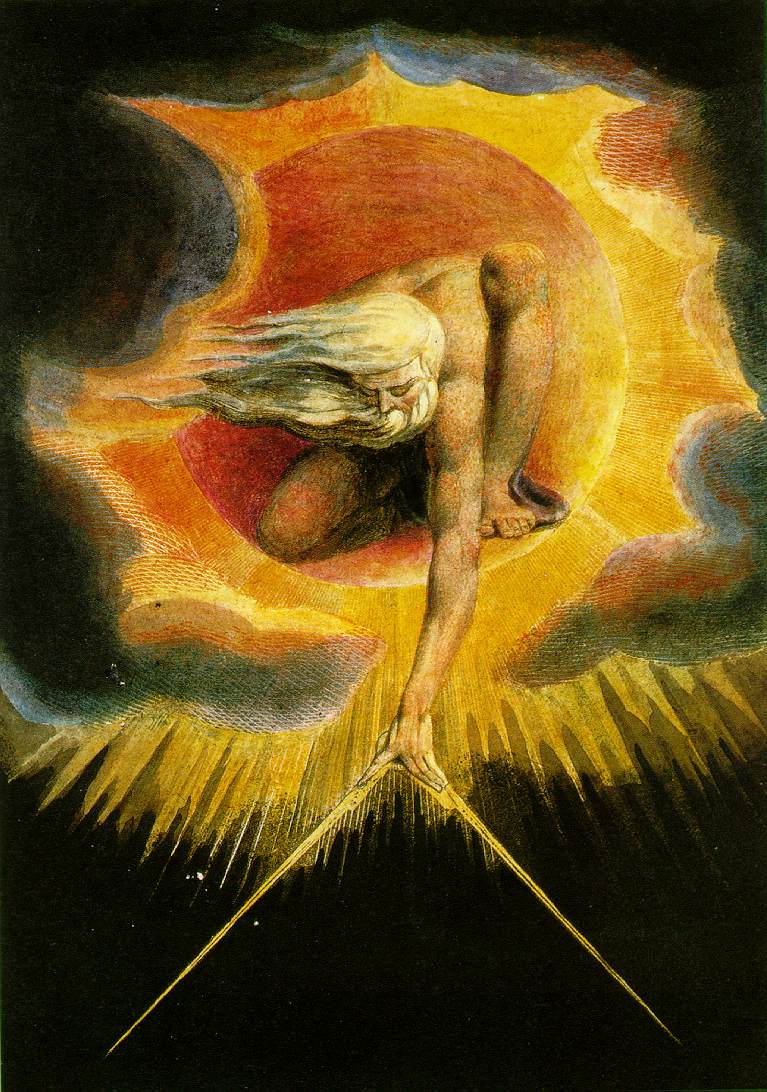
public domain via wikipedia

The Lord is king, let the earth rejoice, let all the coastlands be glad. Cloud and darkness are his raiment; his throne, justice and right. A fire prepares his path; it burns up his foes on every side. His lightnings light up the world, the earth trembles at the sight. The mountains melt like wax before the Lord of all the earth. The skies proclaim his justice; all peoples see his glory. Let those who serve idols be ashamed, those who boast of their worthless gods. All you spirits worship him. Psalm 97:1-7


That is part of Psalm 97 and according to my Divine Office app this psalm foretells of worldwide salvation; that all nations will, one day, believe in Christ. One of the things that I love about praying the Divine Office is how the readings help to stir up wonder and awe. Even when my personal prayer is dry, the Psalms that are prayed in the Office always lift up my heart with wonder, if even for just a moment.  I cannot ponder them enough.

As our contemporary culture continues to embrace materialistic philosophical views of the world, I love being reminded, “the earth rejoices and the coastlands are glad.” I love how the phrase: ‘cloud and darkness are his raiment ‘increases my wonder for the mystery that is Our Lord. It both establishes God’s absolute authority over all, and reveals how those shabby, materialistic philosophies are blind to the great transcendent dignity of man.  Because in each of us is the divine image.

To reduce our humanity to biological chance goes against everything that we are naturally oriented to.  The ancient pagans were much wiser than we are in our present technologically advanced age when they saw divinity in the sun, the moon and the stars.  They may have missed the mark in their worship, but our lot in life -- with everything around us reduced to only what can be quantified and measured -- is so much more demeaning to our true nature.  We are no less blood thirsty than those who sacrificed humans on altars to false gods; we sacrifice our children in abortion for comparatively petty comforts for heavens sake!
 
In the movie The 13th Day , which tells of the appearance of Mary to three children in Fatima, Portugal, there is a scene near the end in which the sun appears to be falling down upon the earth and all the people gathered at the site to witness the promised miracle are screaming and running for their lives.  Where are they running to if the sun is falling from the heavens?   But an elderly woman, who seemed angrily doubtful just before the beginning of the apparition, fell to her knees exclaiming “God, how great is your power!”  It sends chills down my spine and brings tears to my eyes. The power, the might, the gentleness, the love.  The cosmos rejoices, and we simply acknowledge Him and wonder!

It is fitting that this revelation was brought by Mary, whose humility enabled her to be the Theotokus: God bearer.  She has no power to save herself, she receives His power.  God has created us to receive His power, we must begin to have an inkling of the magnitude of that gift, and the humility to empty ourselves of vain, materialistic idols -- especially the idol of self, for we cannot save ourselves from destruction and futility anymore than we can outrun a falling sun -- so that we can be awakened to His mighty presence and allow His image to re-create us. That is your inheritance.

public domain via wikipedia


Peace and Grace to all
Heidi Knofczynski


Sunday, July 7, 2013

Rejoice, Your Names are Written in Heaven

 A reflection on the Gospel for the Fourteenth Sunday in Ordinary Time 


The seventy returned with joy, saying, “Lord, even the demons are subject to us in your name!”  And he said to them, “I saw Satan fall like lightning from heaven. Behold, I have given you authority to tread upon serpents and scorpions, and over all the power of the enemy; and nothing shall hurt you.  Nevertheless do not rejoice in this, that the spirits are subject to you; but rejoice that  your names are written in heaven.”  (Luke 10 17-20 Ignatius Catholic Study Bible)
This reading begins with Jesus sending seventy-two appointed disciples on a mission to proclaim Him in advance of His coming.  These missionaries were to expect hardship, and rejection.  They were being sent like sheep amidst wolves, but His power and authority would be with them.  To hear and receive these chosen disciples was to hear and receive the Lord, and to reject them was to reject God.  Jesus is God-with-us; Emmanuel.  He has humbly taken on our humanity to gather us into His kingdom, where  “You will see and your heart shall exult, and your bodies shall flourish like grass; The Lord’s power shall be revealed to his servants, but to His enemies, his wrath.” (Isaiah 66:15)

And when the seventy-two return to Jesus they joyfully tell of how even the demons were subject to them when they spoke in His name.  But Jesus tells them not to rejoice in their success, even though they are truly wondrous and astounding, he tells them to rejoice because their names are written in heaven.  They are to find their joy in their relationship with the Father.  Is that where your peace lies?  Does it rest in the fact that you are called by name to be with the Lord in heaven?

Monsignor Pope in his thorough reflection on this Gospel writes this about this joy that Jesus is giving them:
“They (the seventy-two) have the joy of success that day.  There will be other days of rejection and even martyrdom.  That’s why Jesus counsels to have a deeper source of joy; merely that they have been called and have their names written in heaven.”
To have our joy and our peace rooted in our relationship with Christ is to have treasure in heaven.  I myself have always felt like an outsider, no matter how long I have belonged to a particular group. I suppose it is because I am a bit on the introverted side, but I am sure that many others know what I am talking about.  I have a really hard time feeling like I belong.  It can be dangerous, I have at time been very vulnerable to clinging to friendships that have been destructive.  This is why it is so important to keep proclaiming Christ's Good News, and so urgent.  There are many who cling to a sense of belonging – to whatever group or situation they have become comfortable with -- to their own ultimate destruction.  They need laborers to bring them the healing and peace that is not of this world, but is from where they truly do belong, heaven.  We all need to be freed from the idols that we cling to so that we can answer His call and know that our names are written in heaven.
 
There really are no sweeter words that one can hear, words that assure you that you are called and that you belong!

May His peace rest upon all of you!

Heidi
Here is a link to the rest of Monsignor's reflection, I guarantee that you will be blessed by reading it! 


Friday, June 28, 2013

Reflection on the Readings for Sunday June 30th

By:   Sharon Nelsen

Waiting for inspirations on this Sunday’s scriptures gives me a deeper appreciation of the process our priest celebrants go through in preparing homilies for each weekend.  It’s easy to go all over the place; yet, in the midst of so many choices, all are called to trust that the Holy Spirit is at work in each of us, struggle as we may, to break open God’s Word in our place, in our time.

My reflections on Sunday’s gospel, rise out of other readings from this month’s liturgies-- readings that struck my heart--especially the gospel from June 27th,  (Matthew 7.21-29) and from June 29th,  (Matthew 16.13-19) the feast day of Saints Peter and Paul. 

In the latter, Peter is given the keys to the Kingdom because he hears, values and acts on the voice of God— Jesus says that hearing the Father is “The rock” on which “I will build my Church.”  (Matthew 16.18).  It’s tempting to become so focused on the headship aspect that we forget the introduction of this “rock” image by Jesus, given to us earlier in the week in Matthew 7.24: “Everyone who listens to these words of mine and acts on them will be like a wise man who built his house on rock.”  This analogy has a physical meaning, obviously, but there is a deeper meaning if we connect the image with Jesus’ words to Peter: Listening to the word of God and acting on it is the rock on which the whole church is built, living stone by living stone.  This is not exclusively about headship, but about “everyone who listens.”

What does all of this have to do with today’s scriptures which thematically are about following? Elisha is called to follow Elijah (1Kings 19.16b, 19-21) and the disciples and others are called to follow Jesus (Luke 9.51-62).  Following God is about keeping an open heart, a listening heart, to God’s Word within and as God’s Word comes to us from others.  “Holy Spirit, make my heart be open to the Word of God, that my heart be open to good, that my heart be open to the beauty of God every day”--a challenging prayer from our dear Pope Francis given to us on Pentecost this year.

We follow Jesus when we are open to doing good, when we become the beautiful, “How beautiful are the feet of the one who preaches good news.” (Romans 10.15).   God is “located” in goodness and in beauty everywhere, even in our daily encounters.  That is what Jesus shows his followers and shows us in the incident with the Samaritan village in Sunday’s gospel from Luke.

Jesus does not judge or condemn those Samaritans who have refused hospitality because their village was not his destination, but just a stopover on the way to Jerusalem.  Furthermore, he rebukes his own followers who want to be like Elijah and “call down fire from heaven to consume” those who have rejected them.  Hospitality is about acceptance; the lack of hospitality is about rejection, and in Jesus’ culture, such behavior carried a “mandate” to defend honor.  Jesus teaches out of the religious tradition of his disciples, pre-empting cultural “rules.” 

What the Lord teaches us to set aside, to dismiss, to not be tempted into, is “getting even.”  When one is justice-oriented, it is an easy slide into getting even, making “it” right.  Jesus is teaching His disciples, and teaching us to build and grow on our foundational principles, principles that have formed our inner faith voice. 

The foundational principles make us living stones, an authentic part of the entire church.  The voice of God within for those early followers of Jesus, would be those who had internalized Leviticus 19.18: “Take no revenge and cherish no grudge against your own people.  You shall love your neighbor as yourself.  I am the Lord.”   By forgiving, not by grudge-bearing and revenge, will others  recognize true disciples of the Lord.

How do we apply the foundational principle of forgiving everyone to those who have explicitly rejected us?  What does Jesus teach us specifically about forgiveness in this brief Samaritan-Non-Samaritan episode?  Forgiveness, he tells us by his own actions, is sometimes just letting it go, overlooking it so to speak, moving on.  Notice the absence of trying to convert “those sinners,” of attempting to make them understand, or even of making efforts to rebuild relationships.

Following Jesus often means working on “our stuff,” and trusting with St. Paul, that “The Lord will rescue me from every evil threat and will bring me safe to his heavenly Kingdom.” (2Tim 4.18)  That evil threat is not exclusively from the outside.  That evil outer threat has power over us because it touches our inner power center – get even, call down that fire!  We are freer to act on the Word of God we hear when we allow God to touch and heal the source of our wounded reactions or responses.

As we truly resolve to follow Jesus, to “Come to him, (believing that each of us is) a living stone, rejected by human beings but chosen and precious in the sight of God,” (1Peter 2.4), we grow in honoring the movement of the Spirit within us.  We blossom into wisdom, building on that solid inner stuff with hearts open to the beauty of God every day, allowing ourselves to “be built into a spiritual house to be a holy priesthood.” (1Peter 2.5).  Yes, indeed: “Everyone who listens to these words of mine and acts on them will be like a wise man who built his house on rock,” (Matthew 7.24) and will stay with the Lord, hearing Him say, “Follow me,” and freely able to leave to God the things of God.


Thursday, June 27, 2013

The Remnant


"They rejected his statutes, the covenant which he had made with their fathers.  The vanity they pursued, they themselves became; they followed the surrounding nations whom the Lord commanded them not to imitate."  2 Kings:17
Photo by Heidi Knofczynski


The word “remnant“ has been coming to my mind a lot lately and I have been trying to write a reflection on it for days, but I could not pull it together (admittedly this is a frequent problem for me).  I keep brushing the word aside thinking that the word remnant seems a tad over-dramatic. Is our culture dying so quickly that those who are still faithful to the Church’s positions on the issues of marriage, contraception and abortion in our Catholic churches are already a mere remnant (even if the pews seem full)?  Surely that is overstating the case!


Yet in headline after headline, and in discussion after discussion, with Catholic individuals who ought to know better, I am finding that adhering to the Natural Law (the Ten Commandments), particularly in political views is not even considered!  Many ( though not all) of my fellow parishioners use a soft sentimentality as the basis for many political positions, how you feel governs your stance.  Anything that causes discomfort ought to be re-defined. This is dangerous because so many of these individuals are willingly handing over to Caesar the powers to bind or loose moral teachings – and if you try to make an argument against that, you are completely misunderstood, because so many lack an understanding of what liberty and freedom really mean!!!  Are we narrowing down to a remnant of faithful Catholics?

Then the Supreme Court’s ruling striking down DOMA and dismissing Prop 8 came down, not unexpected, but still quite ominous, and after reading Elizabeth Scalia’s excellent article titled “The ‘Party’ is victor; Time to save souls and churches” I realized I was not being dramatic at all.  It was the Spirit that place that word in my heart.  Not to cause despair, but to show me that the seeds of renewal are even now being sown.

“So too at this present time there is a remnant , chosen by grace.”  Rom 11:5

The word remnant first popped into my head during the June 7th rehearsal dinner for my son Matthew and his then bride–to-be Grace. They were married on June 8th (Yes! It was the feast of the Immaculate Heart isn't that awesome!!!) after a real courtship that was based on discernment of God’s will for them. These two have a profound respect, for each other and their deepening love, for parental authority and a commitment to Christ through their Catholic faith. In fact, it was their Catholic faith that came shining through all the wonderful parties and joy-filled celebrations. Especially in the beautiful Nuptial Mass, where the Gospel was chanted by a newly ordained transitional deacon and Panis Angelicus , Ave Verum Corpus and Gounod's Ave Maria were beautifully sung. The Mass and all of the celebrations that surrounded it were directly and indirectly proclaiming what marriage truly is: A covenant that is “ordered to the good of the couple, as well as the generation and education of children.” (CCC 1660) Marriage was not just about the two of them, it was a bridging of the past generations to the future ones. It was about the obligations of these two to build up a Culture of Life through their vows to each other and to God.


Both myself and Grace’s mother heard from guests who felt renewed and filled with hope after the wedding. It was so joyfully Catholic! Three generations of the priesthood participated in celebrating it and at least one other young man was undertaking serious discernment for a religious vocation. And it was at the rehearsal dinner that I looked around the room and felt the hope and promise of renewal that God is always offering us! I thought here ,in this room, are some of the remnant, the faithful remnant in an increasingly post-Christian world. God always leaves a remnant. And what a joyful remnant it was! I wish I had words for my gratitude.

 Come Holy Spirit, fill the hearts of your faithful and kindle in them the fire of your love.  Send forth your Spirit and they shall be created.  And You shall renew the face of the earth.

The darkness of the Culture of Death’s attack on marriage, which is an attack on the Church, is even more disheartening because of the ignorant and complacent acceptance of these attacks by so many members of the Church.  In the face of this daunting opposition these young people were joyfully, faithfully Catholic.  They did not hide their faith under a bushel basket, nor were they stridently holding it over those they may have serious disagreements with.  They simply lived it with maturity and with great joy.  Sometimes it takes darkness to appreciate just how bright the light of Christ shines, and in the growing darkness of our world the joy of this marriage shines so brightly for me.   I know that some of our readers have also been graced with signs of hope like this as well, and to these things we hold on to.

We hold on to them and share them with others because the threats that were once vague and veiled and aimed at our Church are solidifying and they are proving to be formidable.  I take no comfort in President Obama’s claim the he won’t force religious institutions to accept gay “marriage”.  It is a hollow promise.  And every day more souls are giving up the fight, because it looks hopeless, because it is much easier to just give in, because no one they know and respect is willing to stand up and proclaim the truth, and take the insult and calumny that will result from it.  The Culture of Life is facing the ravenous dragon in the Culture of Death and we appear to be losing.  But we are not.  Have faith and endure, and be perceptive of God’s signs of hope! There is a remnant, praise be to God!

Go then, rejoice and exalt over the children of the righteous, for they will all be gathered together and will bless the Lord of all ages.  Tobit 13:13 


Matthew and Grace
How about you? Where do you see signs of hope?

And for more encouragement in strengthening and growing the "remnant" check out Deacon Paul's link:  Small Faith Communities
or if reading is more your thing:   Catholic Spirituality Blogs Network

Heidi

This post is also featured on Catholic Bloggers Network :  Scripture, Sunday Readings and Homilies

Saturday, June 22, 2013

The Mantle of Love


The Mantle of Love
(reflection on Mass readings for 12th Sunday Ordinary "C")
by: Deacon Paul Rooney

The Church did well to link together today's First Reading (1 Kings 19:16b,19-21) and Gospel (Luke 9:51-62), because they both point to the same theme.

God calls Elisha, through the prophet Elijah, to become his special servant.  In the story, the "call" is symbolized with the passing of the mantle from the prophet to the candidate.  It is a call to carry the word of God to others.  So that he would not change his mind through human weakness, Elisha "burns his bridges" behind him.  He slaughters his oxen; uses the wooden plows as fuel for cooking the oxen; and then gave the food away.  He was now fully prepared to follow his call, to honor his commitment to become a servant of God by being a servant of God's prophet Elijah.

When we follow this "commitment-bridge" to the gospel today, we see Jesus advising those who want to follow him to check their priorities and the reality of their commitment.  There is no turning back, once you accept Jesus as your Master and choose to answer his call to become his servant.  He uses a farming image to convey the consequences of laxity in this matter.  If a farmer is plowing a field and is constantly "looking back" to see what he has been doing, his rows will become crooked.  Just so the Christian's call.  He must totally focus on the goal, the path to be strictly followed, and commit his efforts totally to the task at hand.

Jesus illustrated the importance of commitment, by "setting his face" to go to Jerusalem.  He chose to say "yes" to his Father's will, even when he knew it would lead to his passion and death.  He had put his hand to the plow without looking back.

So it is with us.  It is not just a matter of believing in Jesus, being baptized and confirmed, and that's the end of it, claiming self-righteously: "I've been saved!"  No, now the task is just beginning!  As St. Paul teaches, we still have to work out our salvation every single day.  In particular, we are all called, without exception, to continue the mission of Jesus, to plow our own fields, to proclaim the Good News of God's love and mercy.   How we do that depends on our state of life, and the gifts that God has freely given to us.  But God can take the little that we have to offer, and turn it into a great abundance for the growth of God's people.  If we do not put our hand to the plow and work diligently for the kingdom of God by the way we live and serve, then our faith will grow lax and we will not become a light that the world desperately needs to see through our Christian witness.

The "mantle" of Elijah and Elisha continues symbolically to this day.  Specifically it appears in the form of the cape worn by monks and bishops, and the cope worn by the presider at Benediction.  It shows their commitment to serve, the commitment of love by these ordained men to the mission of Jesus.

There is one other "mantle" we can count on, the "mantle of Mary."  Our
Blessed Mother taught us what true commitment means, when she said "yes" to God at the time of the annunciation by the Angel Gabriel.  Her mantle of love will protect us!  A good prayer for us is this: Dear Mother Mary, please place your mantle of motherly love around me and my family, and protect us with your intercessory prayers of love.  Please ask your Most Beloved Spouse, the Holy Spirit, to transform us all into the image of your Son, Jesus!

Deacon Paul Rooney
Omaha

Note from Admin:
This post is featured on Catholic Bloggers Network Linkup Blitz

Saturday, June 15, 2013

Reflections on the Readings for the Eleventh Sunday in Ordinary Time -- June 16

  By Judy Morss


This Sunday is Father's Day in the United States. On this day we take time to remember, acknowledge, thank and pray for those men in our lives who have been a father or like a father to us. I think of Joseph, Jesus' earthly father and the role model he was for Jesus. Joseph believed in God, obeyed and trusted God and protected Mary and Jesus. Joseph was an ordinary man, who through God's grace, was an extraordinary part of our salvation.

We are God the Father's children; He watches over us, guides us and protects us.

On Father's Day, I think of my Father and the gifts he gave me. My Mother came from a Roman Catholic background and my Father was a Lutheran. When they married, he promised to raise his children as Catholics. He kept his word. On cold Sundays, he drove us to Mass and then picked us up after Mass. On warm Sundays, my Mother, brother and I would walk to church and back. When we would arrive back home, my Father would usually be sitting on the front porch enjoying the morning. He would ask us how Mass was and then tell us about his conversation with Jesus. I learned early in life that you don't just pray to Jesus asking for things and praying that rote prayer, but you talk with Jesus about the things in your life and He always answers! Sometimes the answer was NO, but He always answered and gave guidance.

* * *


* * *

As I reading the readings for today, the word Forgiveness filled my thoughts.

Taken from 2 Sam 12:13: 
Then David said to Nathan,
“I have sinned against the LORD.”
Nathan answered David:
“The LORD on his part has forgiven your sin:
you shall not die.”


Taken from Psalm 32:5: 
I acknowledged my sin to you,
my guilt I covered not.
I said, “I confess my faults to the LORD,”
and you took away the guilt of my sin.
R. Lord, forgive the wrong I have done.


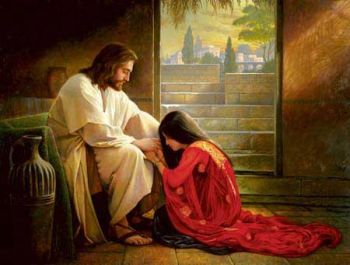
Luke 7:36-50A Pharisee invited Jesus to dine with him,
and he entered the Pharisee’s house and reclined at table.
Now there was a sinful woman in the city
who learned that he was at table in the house of the Pharisee.
Bringing an alabaster flask of ointment,
she stood behind him at his feet weeping
and began to bathe his feet with her tears.
Then she wiped them with her hair,
kissed them, and anointed them with the ointment.
When the Pharisee who had invited him saw this he said to himself,
“If this man were a prophet,
he would know who and what sort of woman this is who is touching him,
that she is a sinner.”
Jesus said to him in reply,
“Simon, I have something to say to you.”
“Tell me, teacher, ” he said.
“Two people were in debt to a certain creditor;
one owed five hundred day’s wages and the other owed fifty.
Since they were unable to repay the debt, he forgave it for both.
Which of them will love him more?”
Simon said in reply,
“The one, I suppose, whose larger debt was forgiven.”
He said to him, “You have judged rightly.”
Then he turned to the woman and said to Simon,
“Do you see this woman?
When I entered your house, you did not give me water for my feet,
but she has bathed them with her tears
and wiped them with her hair.
You did not give me a kiss,
but she has not ceased kissing my feet since the time I entered.
You did not anoint my head with oil,
but she anointed my feet with ointment.
So I tell you, her many sins have been forgiven
because she has shown great love.
But the one to whom little is forgiven, loves little.”
He said to her, “Your sins are forgiven.”
The others at table said to themselves,
“Who is this who even forgives sins?”
But he said to the woman,
“Your faith has saved you; go in peace.”


* * *

What hope these readings bring me. My God is a forgiving God. He knows the magnitude of my sins and yet he forgives them. I need only to sincerely ask for forgiveness and I will receive it. However, Jesus places an interesting caveat on forgiveness. When He taught us to pray, He said "...forgive us our sins as we forgive those who sin against us." In other words, forgiveness is a two-way street. If we hope to be forgiven, we must in turn forgive. That is our challenge.


May Peace, Blessings and Forgiveness be yours,

Judy